 How Mediaeval Wrocław Survived One of Poland’s Most Devastating Earthquakes



Jolanta PAWNIK
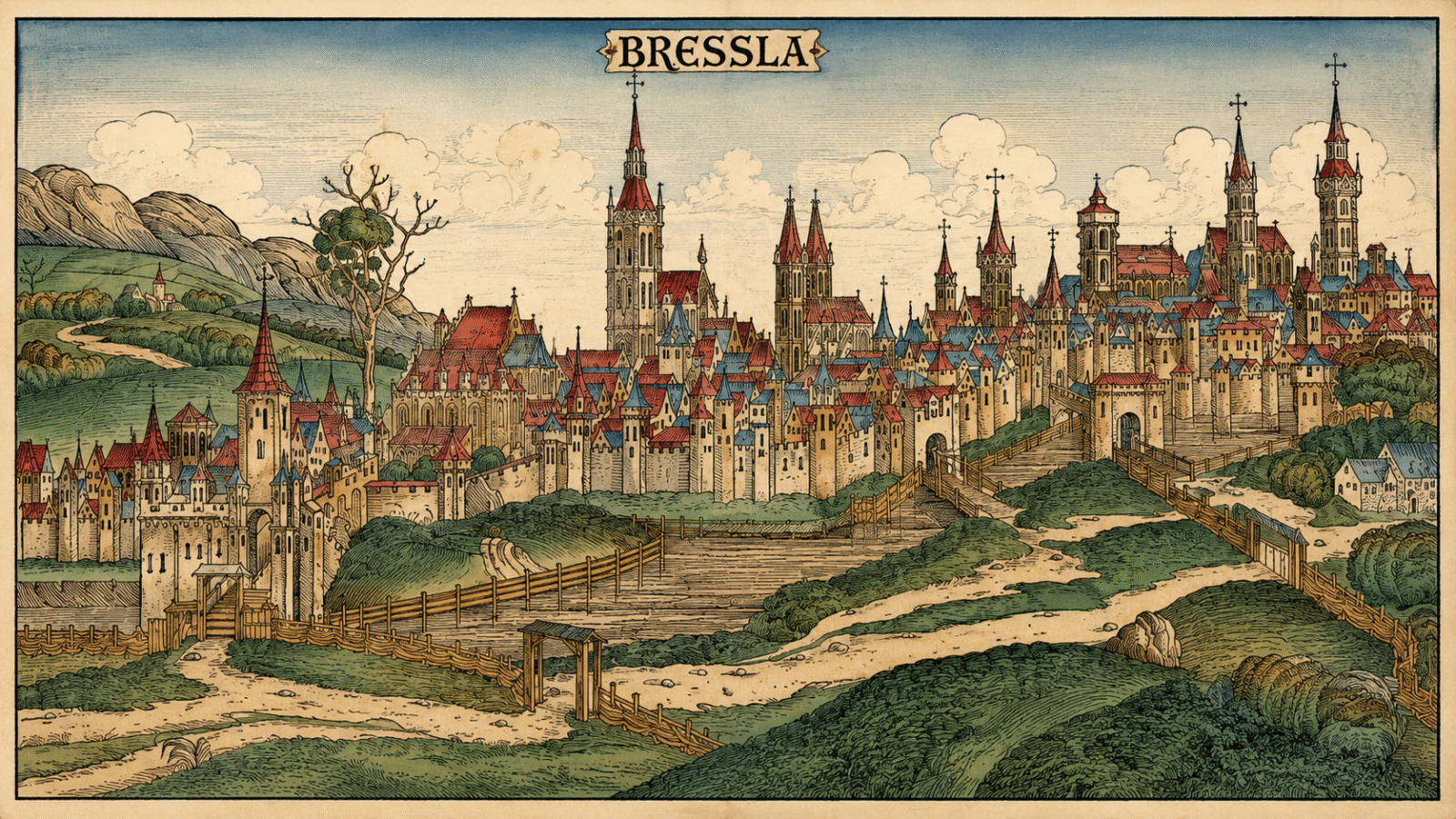
At the beginning of June 1443, the inhabitants of Wrocław experienced an event that neither contemporary chroniclers nor scholars were able to explain. Although the region would go on to experience further seismic activity in later centuries, it is the earthquake of 5 June 1443 that continues to fascinate historians and researchers to this day.
‘On St Boniface’s Day, which occurred on Wednesday, at the thirteenth hour, a great earthquake struck Wrocław and many other regions and towns,’ wrote the city’s chronicler Zygmunt Rosicz in his Gesta diversa facta in Silesia. Rosicz was one of the most distinguished Silesian historians of the Middle Ages. The best-known account, however, was left by the Polish chronicler and royal tutor Jan Długosz, who described the event in Book XII of his Annals, or Chronicles of the Famous Kingdom of Poland: ‘(…) there was a widespread earthquake throughout the land, particularly in the kingdoms of Poland, Hungary and Bohemia, as well as neighbouring territories. It was so powerful that it caused towers and masonry buildings to collapse. Many houses, however solidly built and reinforced, shook violently. Riverbeds were seen lying empty, for the waters had spilled out on both sides. Everything liquid burst forth. People, seized by sudden terror, were driven out of their wits’.
Both the Kraków Calendar and the writings of Jan Długosz focused primarily on the destruction in the capital of the Kingdom of Poland. ‘In the Year of Our Lord 1443, during the Council of Basel, on 5 June at the thirteenth hour, there occurred a great earthquake amid terrifying peals of thunder, so that in Kraków all the walls seemed on the verge of collapse, making a dreadful roar. In many places, sizeable cracks and fissures appeared in walls and vaults, while bricks and stones fell to the ground. (…) It was then that the vault of St Catherine’s Church collapsed,’ we read in the Kraków Calendar. Jan Długosz likewise recorded the damage suffered by some of the city’s most important churches: ‘The roof of the monastery of the Augustinian Hermits of St Catherine in Kazimierz fell to the ground during the night as a result of this earthquake, and many other places were laid to ruin (…). Yet the earthquake was even more severe in Hungary, where several castles collapsed’.
Damage in Wrocław was also noted by Janusz Pagaczewski in his Catalogue of Earthquakes in Poland between 1000 and 1970. He wrote: ‘5 June 1443, 3–4 p.m. Earthquake in Silesia. The macroseismic area extended across Central Europe. Particularly severe damage to buildings occurred in Wrocław and its surroundings; in Brzeg, part of the vault of the parish church collapsed, while in Kraków the vault of St Catherine’s Church gave way. In other Polish towns, buildings suffered only minor damage. The earthquake was strongly felt in Bohemia, Hradec Králové and Moravia (…). It is possible that the epicentre was located in the Sudeten Foreland (…)’.
It is worth remembering that this was a time when people’s understanding of the world rested on very different foundations from those of today, and the boundary between the natural and the supernatural was far less clearly defined. Comets, eclipses, floods and unusual atmospheric phenomena were therefore interpreted not merely as natural events but also as manifestations of a larger order.
Earthquakes were among the most unsettling of all omens, for they disturbed the foundation on which the very world rested. People could seek shelter from the rain, flee from a fire or close city gates against an enemy. But there was nowhere to escape when the earth itself began to move. Perhaps that is why the events of June 1443 remained in memory for so long – not because they constituted the greatest disaster in the history of medieval Silesia that claimed an enormous number of lives, but because they shook the sense of order on which the world seemed to depend and therefore became permanently embedded in the region’s collective memory.
Silesia did not experience further tectonic shocks considered significant enough to be recorded in historical chronicles until the eighteenth century. These included an earthquake in the Racibórz region in 1774 and a series of stronger tremors in the Beskids and along the Silesian–Lesser Poland border in 1785–1786.
A prominent place in the region’s history is held by the earthquake of 11 June 1895, the effects of which were recorded in hundreds of towns and villages across Lower Silesia. Walls cracked, roof tiles and plaster fell from buildings, and residents rushed into the streets, believing they were witnessing a catastrophe. Wrocław also felt the tremors, although their epicentre lay further south, in the Sudeten Foreland region. It was one of the best-documented earthquakes in the history of Silesia, with systematic collection of eyewitness accounts starting to appear the very next day.
Throughout the twentieth and twenty-first centuries, the inhabitants of Lower Silesia have repeatedly felt further tremors, particularly in the copper-mining areas around Lubin, Polkowice and Głogów. Many of these events were linked not to natural tectonic processes but to mining activity.
What is particularly striking is that the story of the earthquake of June 1443 is still not fully told. Geologists and seismologists continue to revisit the event, using mediaeval chronicles to reconstruct what happened nearly six centuries ago.
Modern researchers estimate that of the roughly 140 earthquakes recorded in the territory of present-day Poland over the past thousand years, the one that affected Wrocław was among the most severe. Its magnitude is now estimated at around 6.0 on the Richter scale.