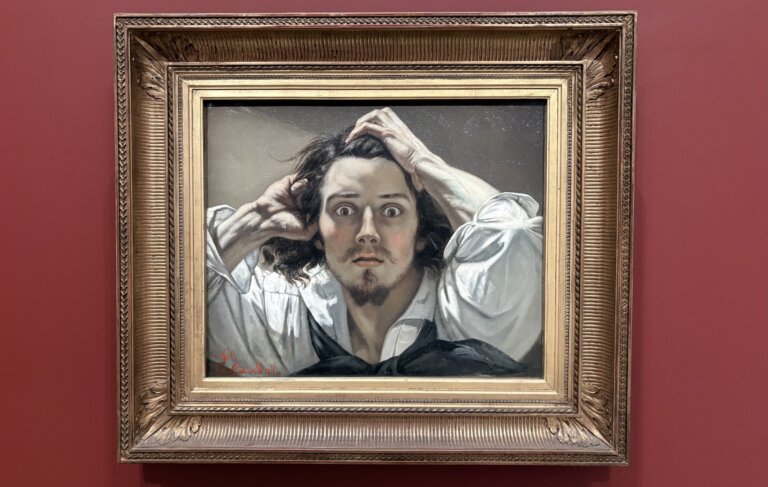
 Rembrandt Can Take It


Anna BIAŁOSZEWSKA
Sometimes, standing in a museum, I find myself entertaining a suspicion I probably ought not to have. I look at a painting by an acknowledged master and think, immediately reproaching myself for the thought: what if this simply isn’t a very good painting?
In memory of Piotr Orawski
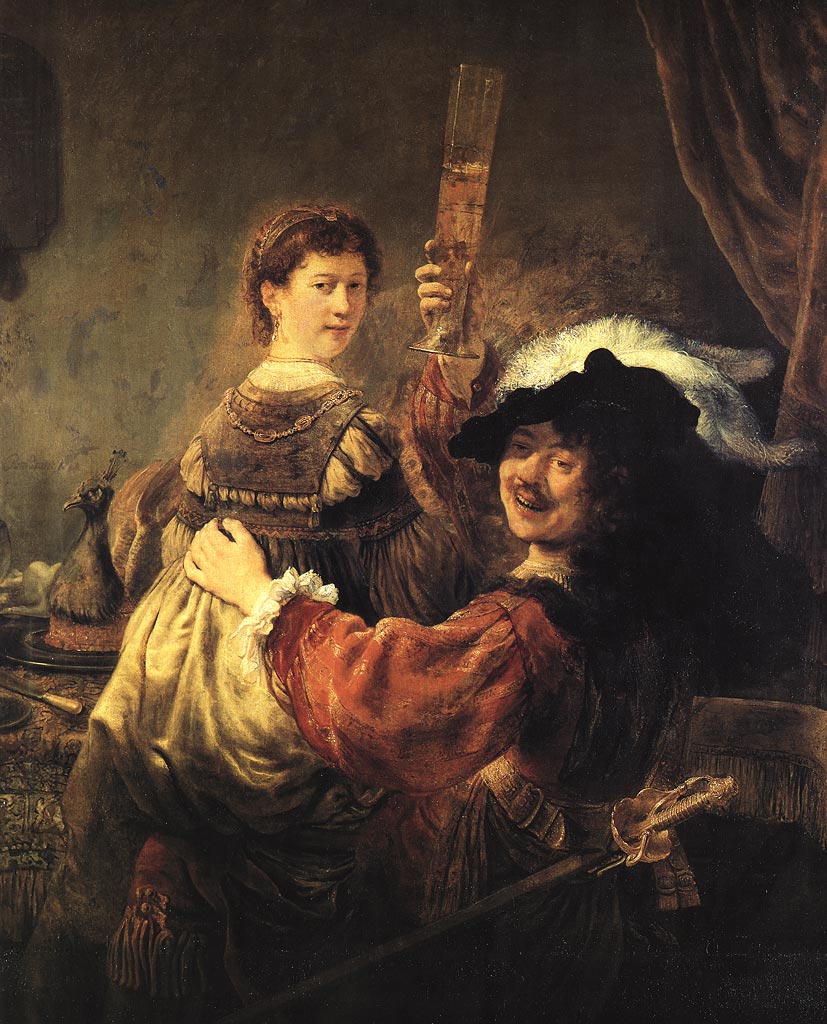
.Once, in Dresden, we stood before a Rembrandt. Rembrandt and Saskia in the Scene of the Prodigal Son. A great painting, an important painting. Rembrandt, with no qualifications necessary.
Except there was something decidedly wrong with Saskia’s head.
We studied her for a while, until one of us remarked that she looked like C-3PO after someone had reattached the poor robot’s head at a rather unfortunate angle. Hers seemed oddly twisted away from the rest of her body, as though the head belonged to Saskia but the torso had been borrowed from someone else for the occasion.
And that was it for Rembrandt.
Not that the painting suddenly ceased to be magnificent. Rembrandt was hardly expelled from the history of art, no thunderbolt of his wrath struck us down, and the museum in Dresden had no reason to take the canvas off the wall. It was simply that, surrounded by some of the greatest paintings ever made, we had noticed something we could never unsee.
And I think it was then, long before I imagined I might one day write about it, that I understood something important: you are allowed to laugh in front of a masterpiece. You are allowed to notice something awkward, to think that a particular detail doesn’t quite work. Even, heaven forbid, to look at a universally admired painting and remain thoroughly unimpressed.
It sounds obvious. Yet the name on a museum label can be remarkably effective as a set of instructions. After all, it’s Rembrandt. The word alone seems to make you stand a little straighter.
Sometimes, standing in a museum, I find myself entertaining a suspicion I probably ought not to have. I look at a painting by an acknowledged master and think, immediately reproaching myself for the thought: what if this simply isn’t a very good painting?
Not 'I don’t like it.’ That’s still relatively safe territory. Taste is personal, and people can be forgiven for theirs.
No, I’m thinking something worse.
What if the painting is actually rather poor? What if the master simply got it wrong? What if he thought so himself?
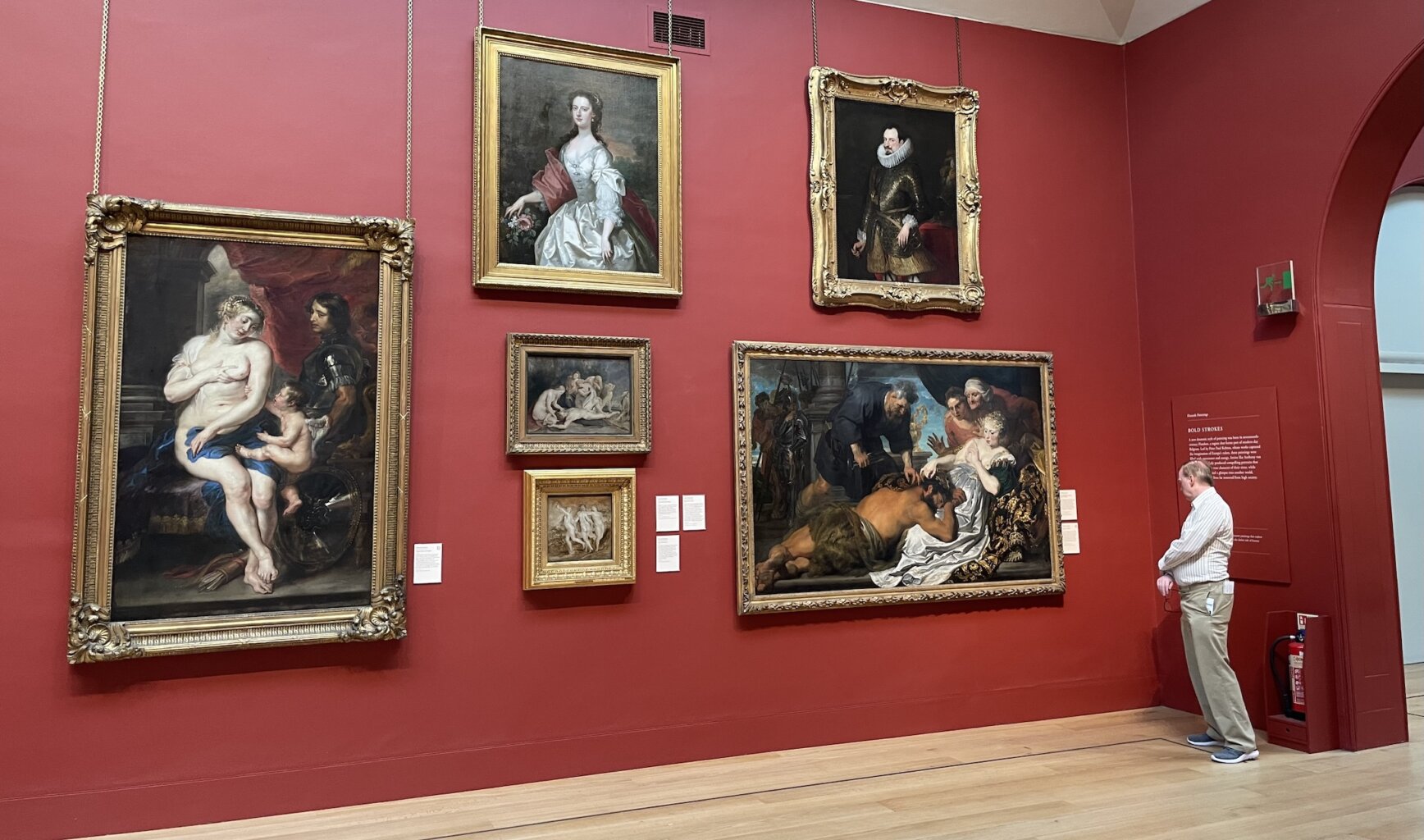
.Surely even the greatest painters must have produced their share of mediocre work. Statistically, it would be astonishing if every single day in the studios of Rembrandt, Picasso or Hopper ended with a masterpiece.
They experimented. Revised. Painted over things. Abandoned them.
And sometimes they couldn’t even bring themselves to stop revising.
Pierre Bonnard returned to his paintings years after supposedly finishing them. In his case, 'finished’ was a decidedly elastic concept. There are stories of him attempting to improve his works long after they had left his studio and entered other people’s collections.
I have a great fondness for this mistrust artists sometimes feel towards their own declarations of 'done’.
Museums, however, teach us precisely the opposite.
Here is the painting. This is what it looks like. It is magnificent. The frame encloses the composition, the label supplies the name and date, the lighting falls at exactly the right angle. The artist has done his part. The art historians have done theirs. The curator has chosen the wall and written the accompanying text.
Now it’s our turn.
Please admire accordingly.
.Yet to the person who painted it, this might have been nothing more than the state of the picture on a particular Tuesday. Given another week, he might have changed the light. A year later, he might have shifted a colour.
Bonnard would probably already be running towards it with a brush.
For that matter, artists themselves have often treated art with considerably less reverence than we do today.
Rubens retouched drawings by old masters in his own collection. These days, the mere suggestion would probably have conservators rushing to secure the museum storerooms.
Mantegna and Bellini were forever looking over each other’s shoulders. Brothers-in-law, both great Renaissance painters, they tackled the same subjects, borrowed compositional ideas and answered one another through their paintings. Sometimes their arrangements are so similar that you almost feel like playing spot the difference.
And the differences are the best part.
The same subject. A similar composition. Yet one artist saw it one way, the other quite differently.
Suddenly, art history stops resembling a solemn procession of solitary geniuses.
You begin to see people.
Watching each other. Borrowing. Experimenting. Perhaps occasionally trying to do it better.
Turner took things a step further.
In 1832, during preparations for the Royal Academy exhibition, he saw an enormous canvas by Constable hanging beside his own painting. Constable had spent years working on it.
Turner walked over to his own picture and applied a small dab of red paint.
Later, he turned it into a buoy.
That was all.
Constable is said to have remarked: 'He has been here and fired a gun.’
I love that story.
Not Turner on his pedestal. Turner looking at a fellow painter’s work and wondering what on earth he could do about his own.
One little dab of red.
And suddenly all that accumulated museum dust falls away.
Because artists themselves did not always maintain the solemn distance from art that viewers were later expected to adopt. They corrected things. Watched each other. Competed. Changed their minds.
Sometimes they even interfered with someone else’s work.
If Bonnard could look at a Bonnard and still see something that needed improving, why should I look at a Bonnard and see nothing but something to admire?
Of course, my position is hardly the same as his. I possess neither his skill nor his knowledge, nor, fortunately for Europe’s art collections, the right to approach a painting with a brush.
But I do have my own eyes.
And I think that’s what I’m trying to defend here.
The trouble is, eventually the artists died.
We took away their brushes, put their paintings into frames and opened their cupboards.
Sometimes I imagine that in one of those cupboards we discover an unknown Hopper.
Not a masterpiece hidden from the world. Quite the opposite. Some unsuccessful experiment pushed against the wall. A canvas that might have been destined to disappear beneath an entirely different painting.
Decades later, someone finds it. Cleans it. Examines it. Frames it.
It receives several metres of empty wall and exactly the right lighting.
And beneath it, a little label.
Edward Hopper.
And immediately we look differently.
We search for light. Loneliness. Silence. Tension.
All those things we have learned to look for in Hopper.
Perhaps they really are there.
Or perhaps some of them only appear once we’ve read the name.
At this point, the rebel in me proposes something positively barbaric.
Let’s take down the labels.
Not just Hopper’s. All of them.
How much of our admiration would survive?
I’d like to believe quite a lot.
But I suspect there would be occasions when we’d walk straight past a painting that, with a famous name beside it, would have held our attention for considerably longer.
And that’s where things get interesting.
Without the label, did we see too little?
Or, with the label, did we begin to see too much?
As a child, I watched Sister Wendy Beckett’s television programmes. This tiny nun in her habit would stand in front of a painting and simply look.
She knew incomparably more about art than I did, but I never remember feeling that at any moment she might spring a test on me to check whether I was admiring it correctly.
She talked about gestures. Glances. Colour. The tension between figures.
And she did so in a deeply personal way.
She could be delighted by a painting, but she was equally capable of finding something quite unconvincing.
For her, knowledge was a way of looking, not an instruction manual for the correct use of a painting.
She stood beside the viewer, not in front of them.
Because knowledge really does change the way we see.
And thank goodness for that.
I simply wouldn’t want the price of learning to be the loss of my right to form my own judgement.
Take Black Square.
First, strip away Malevich. Take away 1915, Suprematism, the 0.10 exhibition, the corner of the room, the reference to the icon.
What’s left?
A black square.
Now give it back everything we know.
Suddenly, the very same square carries considerably more weight.
And rightly so.
But is knowing why a work matters the same as believing it to be great?
I don’t know.
And I think I prefer that 'I don’t know’ to compulsory admiration.
Perhaps I’ve missed something. Perhaps I can read more, come back, look again and change my mind.
I certainly hope so.
I just wouldn’t want to change it because the name on the label turned out to carry more weight than the painting itself.
So perhaps we don’t need to take down the labels after all.
Perhaps we simply need to stop leaving our eyes in our coat pockets when we hand them in at the museum cloakroom.
And if, after all that, Saskia still looks like C-3PO?
Well.
Rembrandt can take it.
Anna Białoszewska