 Stanisław Dróżdż and the Art of Words


Michał KŁOSOWSKI
‘Stanisław Dróżdż taught us to read words we ordinarily pass over without a thought. With “was”, “is” and “will be”, he made a picture of time; with the preposition “between”, he created a space we could enter. His work reveals Wrocław as a city where literature pushed beyond its own boundaries’, writes Michał KŁOSOWSKI
.On the façade of a former air-raid shelter in Strzegomski Square, now home to the Wrocław Contemporary Museum, three words form an hourglass. They pose a question: Where, exactly, does our life exist, given that the past is gone and the future has yet to arrive? The word ‘is’ occupies the central position in the arrangement. It holds the key.
Stanisław Dróżdż was born in Sławków in 1939 and moved to Wrocław in 1955. He studied Polish language and literature and began his career by writing poems. Gradually, he used fewer and fewer words, placing ever greater weight on their position, size and relationship to one another. Individual letters, numbers and punctuation marks began to appear in his work, giving rise to what he called ‘concept-shapes’: pieces in which the way a word is written makes its meaning visible. The term sounds technical, but the experience it describes is simple. We usually look through a word to what it signifies. When we read ‘tree’, we picture a tree without giving much thought to the four letters on the page. Dróżdż drew our attention to precisely what we overlook. He showed that written language occupies space of its own, and that the distances between characters can help create meaning. The reader is made to look at what the eye would normally skip.
Hourglass was created in 1967. It eventually grew into a sequence of 54 panels, in which the words ‘was’, ‘is’ and ‘will be’ change places according to a set pattern. In 2009, after the artist’s death, the first panel was reproduced on the shelter’s façade. At this new scale, the private act of reading became part of life on the street. Passers-by found themselves facing a poem the size of a building. The work draws its force from the relationship between the arrangement of its words and the viewer’s experience, between the familiar and something new, previously difficult to grasp. We can recreate the arrangement, reverse it or look at it again. But we cannot relive our own ‘was’. That distinction makes Hourglass a meditation on the limits of our control over time. We can name time, divide it and mark it on a calendar, but none of these things can stop its passing. To me, there is something distinctly Wrocławian about that.
Even more spare is Forgetting, also created in 1967. With each successive line, the word in the title loses a letter until all that remains is a full stop. We watch the disappearance unfold. There is less and less to read, although for a moment memory preserves the whole word after the page has ceased to do so. Anyone who has tried to recall the voice of someone close to them, or a detail of a former home, may recognise the feeling. We remember that something was there but can no longer recover its form. Yet Dróżdż gives this experience a rigorous structure. Each line is shorter than the last. That alone is enough to make us reflect on loss. In poetry of this kind, restraint leaves room for the reader’s own experience.
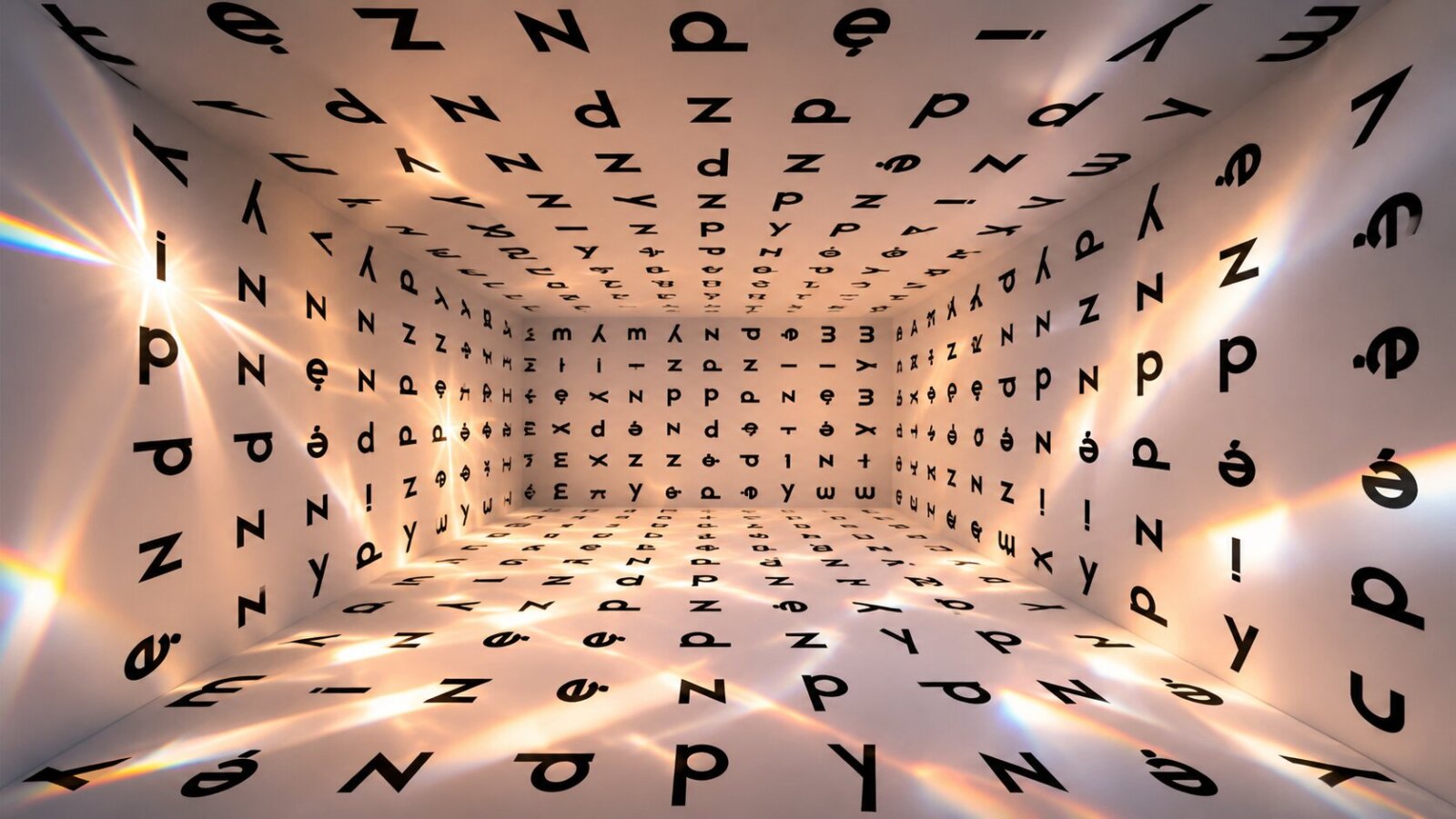
In 1977, at Warsaw’s Foksal Gallery, Dróżdż took the idea further. For his work between, he placed the letters of the title across the walls, ceiling and floor. Visitors stepped inside the text. They had to turn their heads, shift position and search for relationships between the letters. An ordinary word, used almost without thinking, now described their actual position. Between invites us to consider our relationship with language. We learn to speak by entering a world of words already used by others. We use them to describe our own experiences but also inherit the distinctions and associations they carry. Dróżdż made that relationship physical. In searching for meaning, the viewer literally stood between the letters. Their presence became part of what they were trying to understand.
There is, of course, a risk in work of such simplicity. It is easy to admire an ingenious arrangement of letters and assume that, once we have worked out the principle, there is nothing more to discover. Concrete poetry can then seem like a puzzle already solved. Its real test comes when we return to it: can a familiar arrangement still prompt a fresh thought? Seen after a personal bereavement, Forgetting may mean far more than it did when we regarded it chiefly as an experiment in form.
Wrocław gave this experimentation a community in which to flourish. In February 1968, Dróżdż presented his first works of concrete poetry in the entrance hall of the Provincial and Municipal Public Library on the Market Square, alongside an event at which he discussed his work. By holding the exhibition in a public library, Dróżdż introduced a new approach to poetry to an audience familiar with more traditional forms. But Dróżdż did more than exhibit. He helped build a creative community. He compiled an anthology of Polish concrete poetry, published in 1978, organised meetings and conferences, and kept in touch with artists abroad, including Ian Hamilton Finlay and Václav Havel. His contribution to Wrocław also lay in the patient work of creating opportunities for ideas to circulate and making room for art that resisted easy classification.
The physical form of his works was often a collaborative achievement. Artists and designers, among them Stanisław Kortyka and Iwar Romanek, helped realise them. Every idea called for decisions about typeface, proportions and spacing, any of which could alter how the work was received. When meaning depends on the arrangement of characters, a graphic detail carries the weight of a word in a sentence. In 2003, Dróżdż represented Poland at the Venice Biennale with the installation Alea iacta est. Visitors rolled six dice and then had to find their result among all 46,656 possible combinations displayed on the walls. A finite, orderly system came up against the limits of human attention. Knowing that the result was there did not mean being able to find it. Once again, the viewer discovered the rules through participation.
Dróżdż’s poetry made its way beyond galleries and into the streets of Wrocław. As part of the city’s year as European Capital of Culture in 2016, the ‘Paths of Text’ project brought his work to the walls of buildings and to tram and bus stops. Murals on Legnicka and Hubska streets placed it along residents’ everyday routes. People could come across Dróżdż’s poetry on their way to work or while waiting for a tram, without ever setting foot in a gallery. But this kind of presence also makes demands of a city. Displaying a work does not, in itself, guarantee an encounter with its meaning. Even the most radical poetry can eventually fade into the background, unnoticed. It needs to be read afresh, discussed, sometimes simply explained, perhaps even subjected to a playful deconstruction. A city’s cultural maturity is evident, too, in whether it enables residents to engage with their own heritage in this way, particularly when such works have been reproduced so often in public spaces, and above all when they have entered the fabric of the city in forms extending beyond letters and words.
.Stanisław Dróżdż thus left Wrocław a body of work we can experience anew as our lives change. The arrangement of letters remains the same, but we revisit them with a fresh perspective on time, memory and loss. And so the three words on the façade in Strzegomski Square continue to speak to us. We just need to pause and let our eyes linger on them for a moment. Then a simple ‘is’ takes on a deeper meaning.
Michał Kłosowski