 The Hands That Restore Wrocław


Michał KŁOSOWSKI
‘In carpentry workshops, stained-glass studios and clockmakers’ shops, Wrocław’s past is being carefully preserved. Sometimes the task centres on a tenement-house door, a piece of coloured glass or the mechanism of a family clock. How much of that past survives in the things people still use depends on the skill of the craftspeople. This, too, is part of what makes Wrocław so special,’ writes Michał KŁOSOWSKI
.There are many ways to get to know a city: through its landmark buildings, its history and the people who shaped it. But, rather like in the film Notting Hill, you can also start with a door. We can observe how they were made, where years of use have left their mark on the wood, which elements retain their original shape and which have subsequently been replaced. Such scrutiny takes patience, yes, but it allows history to be discovered in places that would otherwise go unnoticed. A door bears the marks of daily life, of repairs and changing fashions. It also embodies the knowledge of someone who, decades earlier, knew which timber to choose, how to fit the pieces together and how to get the proportions right. In a way, that person was doing what an architect does on a larger scale, bringing the different parts of a city together and patiently laying out its streets.
In Wrocław, this physical record of the past matters particularly. After the war, changes to the borders and the population broke the chain of family stories attached to homes, streets and possessions. New arrivals brought their own memories and keepsakes into a city full of things that had belonged to other people. They came to feel at home partly by using those things, repairing them and gradually making them part of their own surroundings. Today, much of the responsibility for preserving that inheritance rests with people whose names you will not find on the façades of the city’s tenement houses: carpenters, stained-glass artists, clockmakers and conservators.
Behind the Akant gallery at 31 Kiełbaśnicza Street is the furniture restoration workshop of Leszek Ukleja. According to the workshop’s own account, its story began in 1981. What started as an interest in wood, model-making, art history and architecture grew into a business restoring furniture and architectural woodwork, including the wooden components of upright and grand pianos. Since 1989, Ukleja has also taught restoration courses. Alongside repairing old objects, he has been teaching others to understand how they are put together and how to make them usable again without sacrificing what makes them valuable. One particularly telling project was his involvement in restoring the Oppenheim tenement house at 4 Plac Solny. Its surviving woodwork, from windows and doors to floors, presented a familiar dilemma: how to respect the original details while meeting the needs of modern users. This task encapsulates one of the central challenges of restoring a city. What should be left untouched? What needs strengthening, and what must be replaced or added? Every choice changes the interior’s character. Old timber ceases to be simply a building material. It becomes a testament to the working methods, tastes and resources of those who shaped the place before us.
Restoration demands a discerning eye. Something that looks beyond repair from a distance may, on closer inspection, prove to have a sound structure, carefully made joints and details worth saving. The reverse can be true as well: an attractive finish may conceal serious damage. Knowing the difference takes experience and an honest assessment. That is why the value of a craftsperson’s work cannot be judged simply by the time spent on a job. What we pay for is also the years of learning, an understanding of materials and the judgement to anticipate the consequences of each intervention. A good repair should extend an object’s life to the benefit of a new generation.
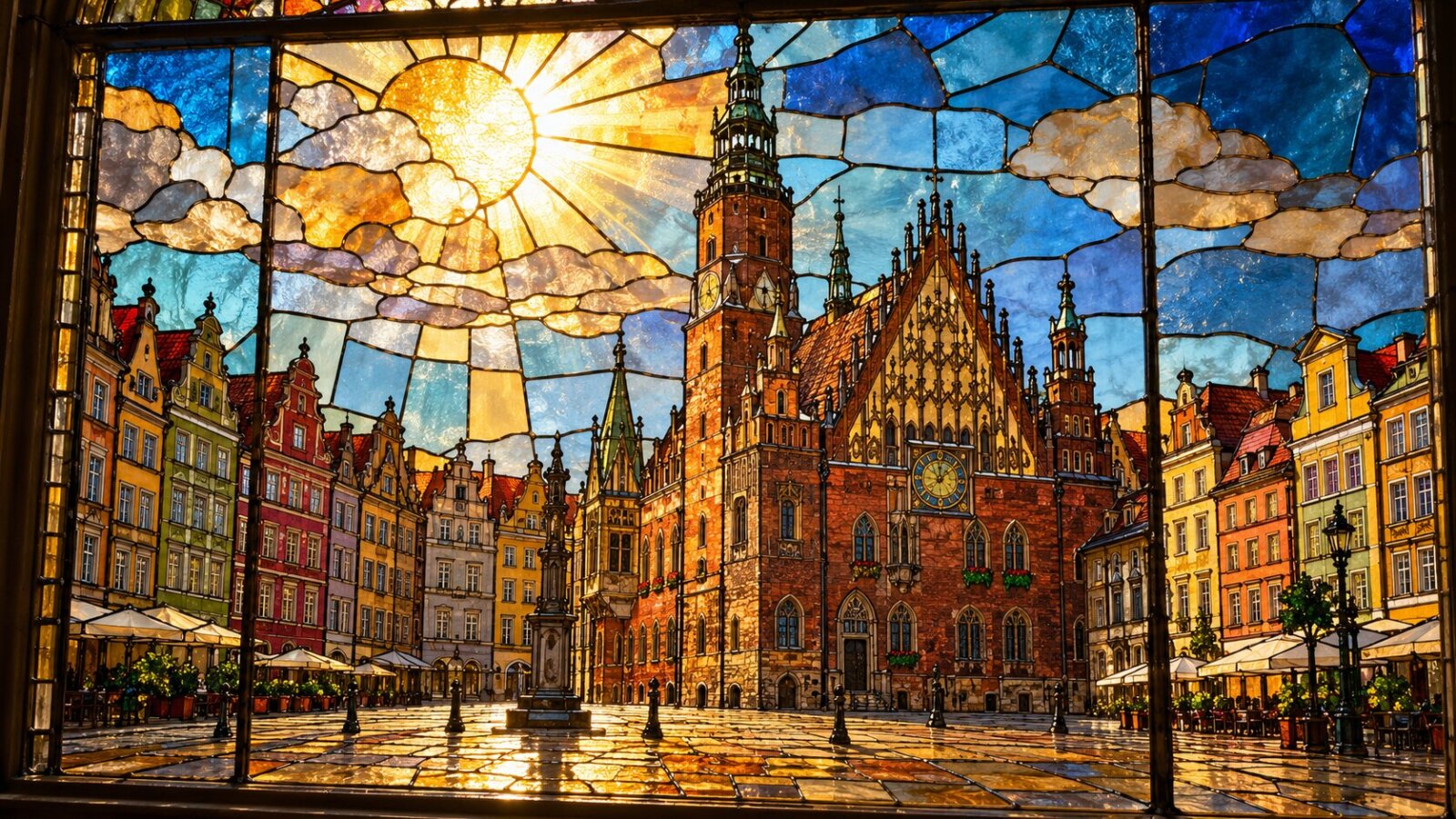
At number 7 on the same street operates Tiffany Ursta, the Stadtmüller family’s studio specialising in lamps and stained glass. Its story began in 1985 in Uraz, near Wrocław, where Małgorzata and Ryszard Stadtmüller set up a workshop in their own 200-year-old house. There they made lamps and other glass objects using the Tiffany technique. In the 1990s, they opened a gallery, shop and workshop in Wrocław. According to the studio’s website, it is now run by Kajetan Stadtmüller, a graduate of the Academy of Fine Arts in Wrocław. The family creates new pieces as well as conserving and reconstructing historic stained glass. Few things show more clearly how craftsmanship becomes part of architecture than a stained-glass window. The way we perceive it is shaped by the light, the time of day and the space in which it is set. Replace a missing section, and you change the composition, the colours and the way light passes through. The Stadtmüllers have undertaken projects for Wrocław’s churches and tenement houses, as well as the White Stork Synagogue. Their projects trace another kind of map across the city, connecting places where glass, light and human skill come together.
The history of stained glass in Wrocław is also enriched by the contributions of Helena and Krzysztof Hadaś. They established their studio in 1984 on Rudolf Weigl Street. They specialise in designs assembled from bevelled and engraved glass. Each finished window is the result of a succession of exacting tasks: designing, cutting, grinding, polishing, decorating and assembling. The studio also restores glass. When we look at a window, we usually see the finished result; rarely do we consider how many decisions had to be made before it could take shape.
Another part of this story leads to Zbigniew Jaworski’s workshop on Ostrów Tumski. According to the city’s website, he began training in 1980 and opened his own workshop in Stabłowice six years later. His creations can be seen in Wrocław Cathedral, the Church of the Holy Cross and the Old Town Hall, among other places. He collaborated with Jerzy Nowosielski and Bronisław Chromy, and has also devoted considerable attention to bringing historic stained-glass windows back to life, restoring both their beauty and their function.
The relationship between a painter and a stained-glass artist shows how much art can depend on people with different skills understanding one another. A painted image has to be translated into glass, with all the possibilities and limitations of the material taken into account. The craftsperson is not merely following instructions: knowing the medium, they can suggest solutions and foresee how the finished piece will look. Conservation adds another dimension to that exchange, bringing today’s specialists into contact with the people who made the original windows. Jaworski has described taking old stained glass apart as a chance to learn. Even after years in the trade, another person’s methods can still surprise you and make you reconsider your own.
At 10 Przejście Żelaźnicze, the same sense of responsibility is directed towards the intricate workings of clocks. Janusz Laudański opened his repair shop there in 1979, converting a former garage into a place to practise his trade. His son Michał later joined the family business. Published accounts describe a workshop that has handled both antique timepieces and clocks valued above all as family keepsakes. Laudański has also repaired clocks belonging to the National Museum in Wrocław, making replacement parts himself when none were available.
A clock is a particularly evocative family possession because we remember it through sound as well as sight. Its chimes may bring back a grandparent’s home, the rhythm of Sunday lunch or the hour of bedtime. A feature about the Laudański family’s workshop repeatedly emphasised this point: people bringing in objects whose significance goes far beyond their market value. The owner proceeds with the repair even though it might cost more than the clock’s monetary value. What they wish to save is a part of their own life. In a city whose history has been so profoundly shaped by displacement and the loss of home, choices like these deserve attention.
The work of preserving memory does not stop at the workshop door. In 2023, the city’s website reported on the conservation of the entrance hall of a tenement house more than a century old on Pomorska Street. A team from Piotr Pelc’s heritage conservation studio spent nearly seven months on the project. Beneath successive coats of paint decorative wall paintings were discovered. Women living in the building helped to save them, while Filip Heliasz played an important part by drawing a conservator’s attention to the interior. An ordinary refurbishment was halted, allowing the newly discovered painted decoration to be protected instead. The story is a reminder that preserving a city’s heritage often begins with a single observation. A person spots part of a pattern, decides it deserves attention and finds a specialist who can judge what has been uncovered. Then come the permissions, the money, the cooperation and the long months of painstaking work. The rescued entrance hall remains part of the residents’ everyday lives. They pass through it carrying shopping, collecting their post or coming home from work. Thanks to the conservation, the beauty of the old interior can once again be part of ordinary life.
There is another question running through all these stories: who will learn the skills next? A workshop can survive a change of address or owner, a new way of organising the business or even a shift in technology, provided someone is there to carry on the craft. Knowledge that has never been shared is much harder to save. Some of it can be written down or photographed, but learning to judge a material, work with a steady hand and sense the right proportions takes practice. Courses, family succession and time spent working alongside a master therefore matter far more than the fortunes of any one business. They help a city retain the ability to care for what it has inherited.
.Together, Wrocław’s workshops tell a distinctive story, one worth sharing with residents and visitors alike. Behind every restored window, rescued wall painting and clock brought back into working order are people with names, skills and lives of their own. Learning about them changes the way we see the streets. We begin to notice the details and appreciate the effort needed to preserve them. And perhaps, next time we pass an old door, we will stop for a little longer to look at the wood, the joints and the signs of past repairs, and think about the hands that have kept it opening all these years.