 Mind the Tarasin. On Art That Doesn't Always Come Through Unscathed


Anna BIAŁOSZEWSKA
Perhaps, then, our sense of a work’s perfection also depends on the appearance we have grown accustomed to. Researchers associated with Sapienza University in Rome decided to investigate how people respond to paintings with missing areas. The results did not produce a simple division between experts who accept damage and laypeople who demand works in perfect condition. Those without specialist knowledge found incomplete representations particularly difficult to accept. Art historians also preferred paintings without losses, while conservators reacted differently.
.Perhaps our idea of a work of art’s perfection depends partly on the version of it we have grown accustomed to seeing. Researchers at Sapienza University of Rome set out to investigate how people respond to paintings with missing areas. The results revealed no neat division between experts willing to accept damage and laypeople demanding works in pristine condition. Those without specialist knowledge found incomplete images particularly difficult to accept. Art historians, too, preferred paintings without losses, while conservators responded differently.
Not long ago, I visited the home of some art collectors. Hanging on the wall was an enormous painting by Jan Tarasin, with a small area of damage that was barely visible unless you looked at it from just the right angle. My hostess explained that they had bought the painting in that condition. They knew about the damage, had accepted it and evidently saw no reason to turn down a Tarasin because of it.
The conversation moved on to other works in the collection. Magdalena Abakanowicz’s walking figures have to be dusted, which strikes me as a rather peculiar undertaking, though dust, after all, is under no obligation to know its art history. Then there was an impressive poppy-red sculpture in the garden. The owners had decided against lending it for an exhibition, fearing it might suffer in transit. It manages well enough in the garden, but a long journey is another matter entirely.
It occurred to me that a museum has one fundamental advantage over a private home: nobody tries to lead a normal life in it. There is no furniture to rearrange, no need to worry that someone doing the housework might catch a protruding part of a sculpture. Museum exhibits have safety procedures and specialists keeping an eye on their condition. In a private home, meanwhile, even the greatest artist has to come to terms with the fact that, sooner or later, the cleaner will turn up.
.But it was the Tarasin that interested me most. Or rather, the damage that apparently did not bother its owners. I noticed that the moment I learnt it was there, I began looking for it. Instead of taking in the composition, the arrangement of forms and the relationships between colours, my eyes kept returning to that small patch of the surface. It was as though the painting had suddenly become defined chiefly by what was wrong with it. Yet only moments earlier I had been looking at exactly the same work without feeling anything of the sort.
A single piece of information was enough to change the way I looked at it.
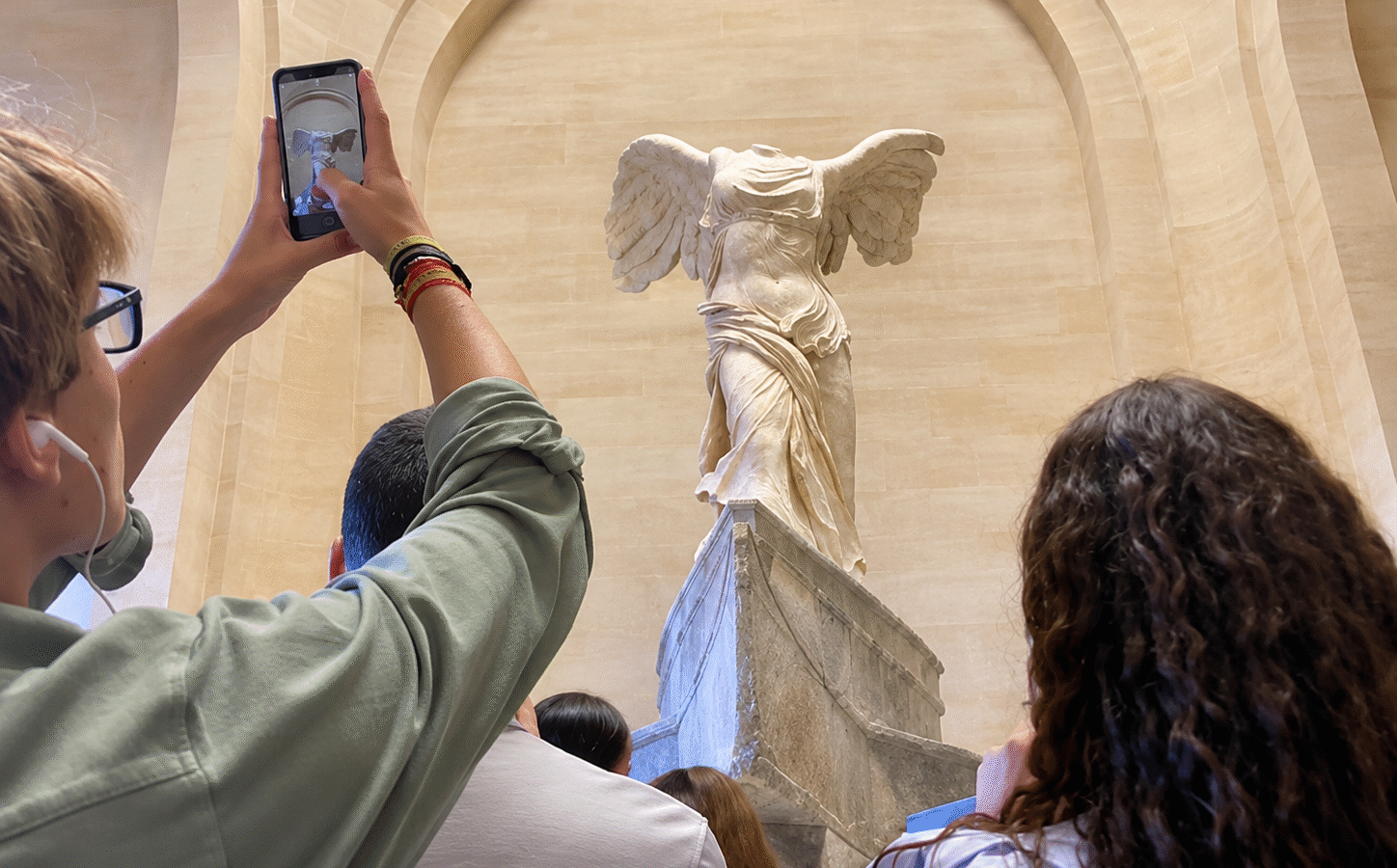
I wonder whether we would react in the same way to a damaged work hanging in the Louvre. Or perhaps that is precisely where we find it easier to accept imperfection. After all, one of the museum’s greatest attractions is a sculpture missing its head, both arms and parts of its wings.
The Winged Victory of Samothrace.
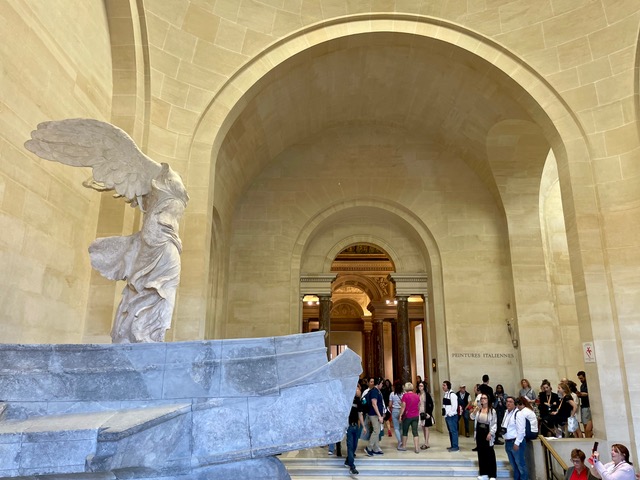
She stands at the top of the Daru staircase, her wings spread wide. The wind presses against her body, flattening the thin fabric against her torso before catching and tossing the folds below. Marble behaves almost like silk. The goddess looks as though she is just about to land on the prow of a ship, although she has remained motionless for more than two thousand years.
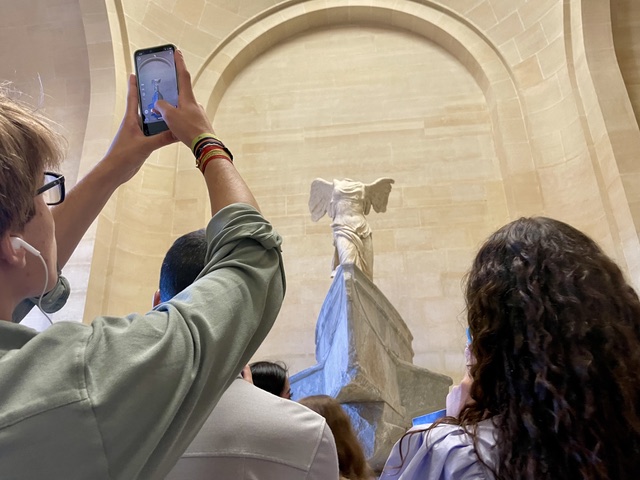
.There is no face on which to read the triumph of victory. We do not even know exactly how her arms were positioned. And yet the sculpture conveys movement and victory so powerfully that it is difficult to imagine her looking any other way.
The Winged Victory, however, did not immediately become the star of the Louvre. When Charles Champoiseau discovered her on Samothrace in 1863, the statue lay in fragments. Attempts were made to reconstruct it in Paris, but it was initially displayed without its wings. The public showed little interest. Only later did researchers establish that the marble blocks found nearby formed a base shaped like the prow of a ship, on which the goddess had originally stood.
The blocks were brought to Paris in 1879, and further missing sections of the sculpture were reconstructed. In 1883, the Winged Victory took her place on the monumental Daru staircase.
And that was when her great career began. Today we marvel at an incomplete sculpture, although an earlier version, equally incomplete, had failed to arouse much enthusiasm. Apparently, we were prepared to forgive the goddess for losing her head only once she had regained her wings. The right wing, incidentally, was made of plaster, modelled on the surviving left one. Parts of the torso are plaster too.
The Winged Victory, which we regard as one of the greatest achievements of ancient sculpture, therefore owes part of her present appearance to nineteenth-century restorers. This does not trouble us in the slightest. We do not go to the Louvre to admire plaster additions, although without them the sculpture would look entirely different.
.But what if her head were found? Would we gaze upon the goddess’s face with the same admiration, or might we feel a certain disappointment? We have grown so used to its absence that a completed sculpture might seem strangely unfamiliar. Perhaps a complete Winged Victory would be even more beautiful. We have no way of comparing the two. The difficulty is that we know the missing parts only through our imagination, and imagination can be remarkably generous towards things it has never seen.
Our minds are happy to fill in what is missing, reconstructing the whole from a fragment. Yet with the Winged Victory, we have long since ceased to need to do so. We have learnt to look at her without a head. What was once a glaring absence has become part of her familiar image. We would recognise the goddess instantly, even in a poor reproduction, although we might have considerably more trouble recognising her own face if it were suddenly discovered.
Perhaps, then, our sense of a work’s perfection also depends on the appearance we have grown accustomed to. Researchers associated with Sapienza University in Rome decided to investigate how people respond to paintings with missing areas. They showed participants sections of old paintings, some with damage added digitally. The experiment involved conservators, art historians and people with no specialist training.
The results did not produce a simple division between experts who accept damage and laypeople who demand works in perfect condition. Those without specialist knowledge found incomplete representations particularly difficult to accept. Art historians also preferred paintings without losses, while conservators reacted differently.
.So a degree in art history is not enough to make someone fond of damaged paintings. But looking is something we learn, too. I notice that once I know the story behind a work, I begin to see it differently. Sometimes it takes another person’s observation to draw my attention to a detail that had previously left me completely unmoved. And sometimes the story of a work turns out to be almost as interesting as the work itself.
Marcel Duchamp would have provided psychologists with excellent material for a study.
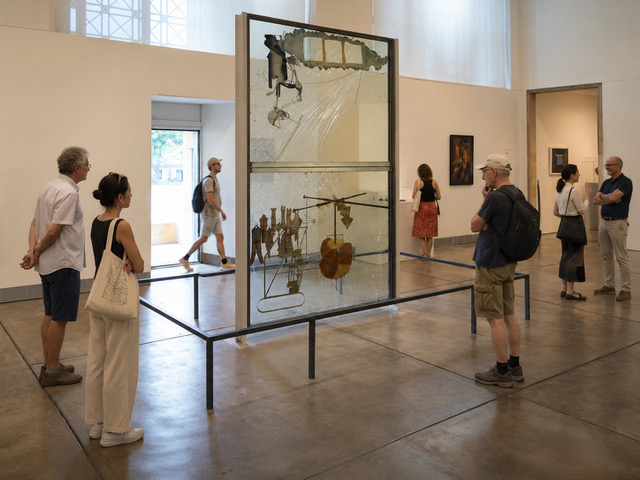
He spent eight years working on his famous Large Glass, or The Bride Stripped Bare by Her Bachelors, Even. Across two enormous sheets of glass, he created an intricate composition resembling an extraordinarily sophisticated machine whose purpose would be difficult to guess. The Bride occupies the upper section, nine Bachelors the lower, and between them unfolds a peculiar spectacle of mechanical desire.
Duchamp had a gift for presenting human passion as though it came with an instruction manual.
At some point, the work cracked during transport. The exact date is unknown, but it probably happened in the late 1920s. Cracks spread across the glass, creating a network of lines that the artist had never intended. Duchamp repaired the damaged structure in 1936 but left the cracks intact. He later remarked that they had improved the composition. He liked their symmetry and the part played by chance.
Eight years of careful work, and then an accident comes along and has an idea you never did.
Today it is almost impossible to imagine The Large Glass without its distinctive cracks. They seem entirely at home in its mechanical world, where chance had played an important part from the outset.
Indeed, Duchamp came to take the cracks so seriously that he reproduced their pattern in the miniature versions of the work made for his portable museum, the Boîte-en-valise.
But I wonder whether we would accept those cracks quite so readily if the artist had regarded them as a disaster. Their pattern, after all, would be exactly the same. It seems that our attitude towards damage may be determined by something we cannot see on the surface of the work: the artist’s opinion of it. And artists can be considerably less forgiving of their own work than collectors or museum visitors.
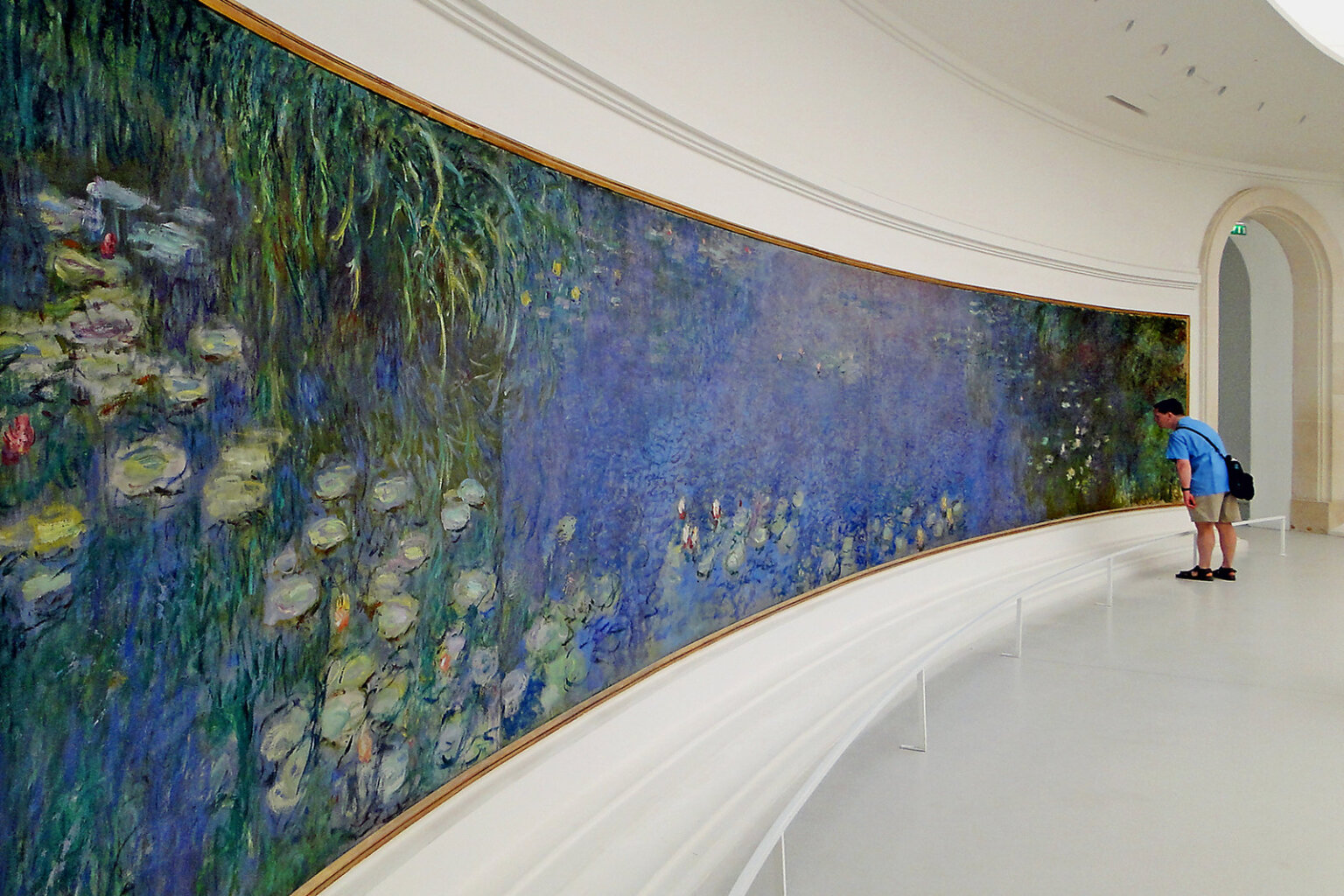
During the final years of his life, Claude Monet worked on the great Water Lilies paintings that can now be seen at the Musée de l’Orangerie in Paris. He painted enormous canvases, returning to them again and again, correcting and altering the compositions. He constantly postponed the moment when he might finally consider them finished. Some of the paintings he destroyed.
His friend Georges Clemenceau tried to persuade him that he had already achieved everything that could be achieved with a brush and a mind. He wrote to Monet in 1922, when the painter was still demanding more time to make changes to the canvases he had promised to the French state. The attempt was largely unsuccessful. Monet kept the paintings in his studio until his death in 1926.
There is something moving about this. A man whose paintings we now admire so deeply was unable to accept the results of his own work. We do not know whether the canvases he destroyed were actually inferior to those that survived. Perhaps he was right. But even the greatest artist can be mistaken. Particularly when judging his own work. Monet, of course, had one advantage over the viewer: he knew exactly what he had set out to paint. We see the result.
He presumably saw everything he had failed to achieve as well. And that may have been unbearable.
The owners of the Tarasin had managed to accept a flaw over which they had no control. Monet could not always come to terms with what had emerged from his own hands. Artists really can be difficult to please.
Monet’s story has another surprising twist. When the Water Lilies rooms opened at the Orangerie in 1927, the public was hardly overcome with admiration. For years, the monumental paintings attracted relatively little interest.
It was only after the Second World War, with the development of abstract painting, particularly in America, that people began to look differently at Monet’s final works. They saw in them artistic solutions that earlier audiences had failed to appreciate. In 1955, New York’s Museum of Modern Art acquired one of the large canvases from the series, further strengthening interest in the artist’s late work.
And yet the paintings had not changed. The viewers had.
This is what makes the thought of those destroyed canvases especially difficult for me to accept. Monet could not have known how future generations would learn to look at his paintings. Perhaps what struck him as a failure would have fascinated us most.
On the other hand, do we have the right to expect an artist to preserve everything he creates, just in case art history changes its mind one day? Ideally, he should catalogue it all, store it safely and leave it in a condition suitable for future research. We want our artists to be uncompromising. An impeccably preserved archive of their failures would be rather useful too.
Robert Rauschenberg, meanwhile, decided to see whether a work of art could be created by removing something that already existed. Fortunately for him, he began by asking the artist’s permission.
In 1953, he visited Willem de Kooning, one of America’s most highly regarded painters, and asked him for a drawing. He had no intention of framing it and hanging it on a wall. He wanted to erase it. De Kooning agreed, although according to Rauschenberg, the decision was far from easy for him. The younger artist took the drawing back to his studio and spent weeks removing the marks left on the paper. The result was an almost blank sheet, set in a gilded frame.
Today we can see it at the San Francisco Museum of Modern Art, under the title Erased de Kooning Drawing.
The greatest paradox is that Rauschenberg erased the drawing precisely because he held its creator in such high regard. He had previously tried the same procedure on his own work but felt that the result lacked the effect he wanted. Only the erasure of a drawing by an established painter could give the undertaking the necessary weight.
A rather unusual tribute. Most people show their admiration by trying to preserve someone else’s work. Rauschenberg decided that the best way to honour de Kooning was to get rid of his drawing.
But try looking at that sheet of paper without knowing its story. It depicts virtually nothing. You would be unlikely to linger over it. Only when you read the label do you start searching for traces of the vanished drawing. And suddenly that almost blank piece of paper becomes considerably more interesting. You find yourself trying to imagine what exactly has been erased.
After all, an empty space where a painting once hung is hardly likely to inspire anyone. Unless, of course, you learn that there was a Rembrandt hanging there just moments ago.
In 2010, specialists at SFMOMA used infrared imaging and digital image processing to reveal some of de Kooning’s erased marks as part of their investigation into the work’s history. It is hard not to appreciate the irony. Rauschenberg spent weeks trying to remove something, and decades later conservators devoted enormous effort to finding out exactly what he had removed.
During an earlier conservation treatment, in 1988, another unfinished de Kooning drawing was discovered on the back of the sheet, depicting a female figure. It had remained hidden for years beneath the paper backing. Rauschenberg had therefore erased the master’s work on one side while leaving the other almost untouched.
I wonder what he would have made of all this research. By recovering and documenting what he removed, are we helping to understand his work, or are we taking away some of its mystery?
In Dortmund, another woman proved equally effective at removing traces of something. Except that she had absolutely no intention of creating art.
In 2011, an employee of a cleaning company working at Museum Ostwall noticed a deposit in the rubber trough that formed part of Martin Kippenberger’s installation Wenn’s anfängt durch die Decke zu tropfen (When It Starts Dripping from the Ceiling). She decided to clean it off. The deposit disappeared, and with it part of the work’s original appearance. The installation as a whole was valued at around €800,000.
A museum conservator concluded that the removed layer could not be accurately restored.
I have a soft spot for this story, although I do feel rather sorry for the woman at the centre of it. She did exactly what people employed to clean things are normally paid to do. She saw dirt and removed it. Her misfortune was that, in a museum, even dirt can have an artist’s name attached.
Interestingly, the installation belonged to a private collector who had placed it on long-term loan to the museum. He presumably expected it to be safe there. It is difficult to blame him.
After all, where else, if not in a museum, should we expect works of art to receive special care?
I am reminded of the sculpture in my hosts’ garden. They had refused to lend it because they feared it might be damaged in transit. Kippenberger’s collector had entrusted his work to a museum, where it suffered precisely the sort of mishap he would probably never have thought to guard against.
And Kippenberger himself? He was an artist with an exceptionally mischievous sense of humour. I wonder how he would have reacted to the news that someone, through an excess of diligence, had removed part of his work.
Perhaps he would have recognised another of the absurdities he so enjoyed exploring in his art. Or perhaps he would have been furious. Sadly, we shall never know, as he had died fourteen years earlier.
The cleaner in Dortmund was not trying to provoke anyone. She needed no manifesto, no exhibition devoted to her intervention. She was simply trying to do her job properly. And perhaps that is precisely what makes the story so funny. Provided, of course, that you are not the owner of an €800,000 installation.
It is also difficult to avoid thinking how much in the art world depends on who happens to be holding the right tool. Rauschenberg had an eraser. The cleaner had a cloth.
One went down in art history. The other would probably rather forget the whole business.
And the Tarasin? Its owners had evidently made their peace with the damage long ago. All it took was for someone to tell me about it, and I went seamlessly from looking at a painting to conducting an inspection. One moment I was interested in the composition; the next I was shifting a few steps to one side to see what was wrong with the picture.
The only thing missing was a torch.
I promised myself that I would look at the Tarasin without prejudice. But I now know exactly where to stand for the best view of the damage. And something tells me that if I ever have the chance to see it again, that is where I shall stand first.
Anna Białoszewska