 Who Let the Bucket into the Gallery? Or, Art with the Right Connections


A woman is swinging a bucket on a rope. She moves through a series of gestures, shifts her body, and the metal bucket rattles as it traces one arc after another through the air. I watch and wait for something to happen. Not to the bucket, which seems to be performing its part perfectly well, but to me. Absolutely nothing happens.
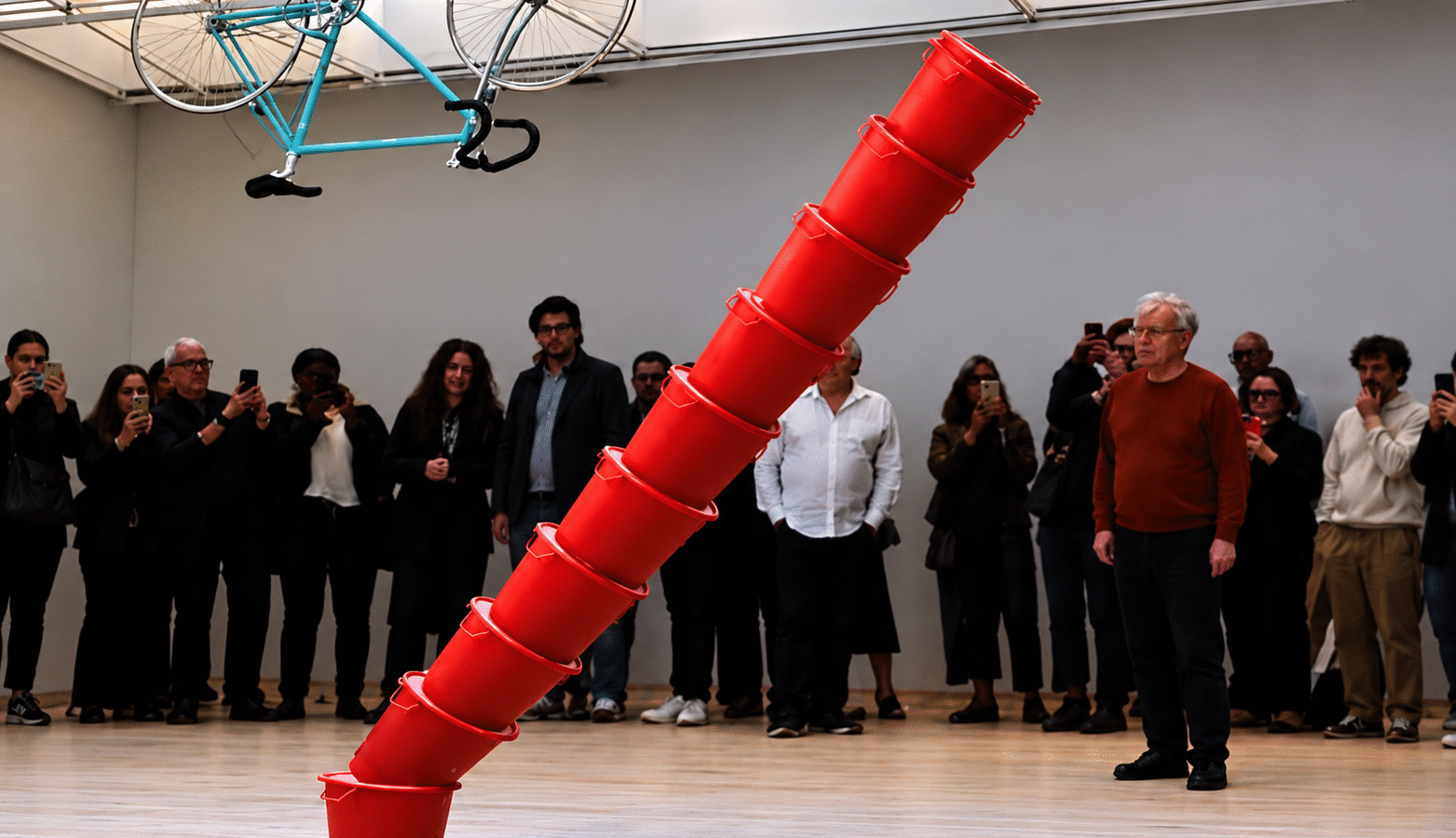
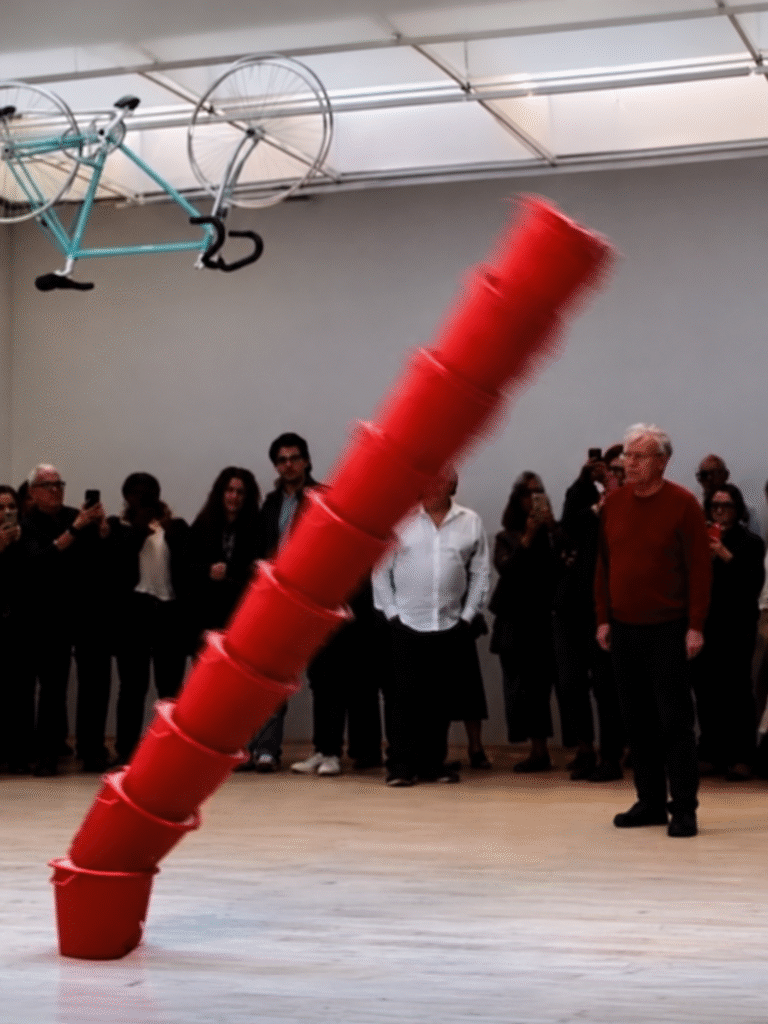
.Elsewhere, red buckets filled with sand have been stacked on top of one another. I examine them with roughly the same level of interest I would normally reserve for the contents of a storage cupboard. But this time, it turns out I’ve missed something important. Sand is slowly escaping through holes in the bottom container. The structure gradually loses its balance, begins to tilt, and eventually collapses with a crash.
The artist is Roman Signer, a Swiss artist who has spent decades experimenting with time, movement and physical forces. In Sand Column, what interests him is not so much the collapse itself as everything leading up to it: the slow loss of sand, the growing instability, the anticipation of the moment when the structure can no longer support its own weight. We know what is going to happen. We just don’t know exactly when. A few buckets become a peculiar little spectacle, with tension supplied by escaping sand and the grand finale courtesy of gravity, which doesn’t even charge a fee.
.Do I now consider the work a masterpiece? Not necessarily. But I can see an idea in it that I initially overlooked. And that, to me, is what makes it interesting. Surely there must be something between an instinctive shrug and unconditional admiration: the possibility of looking more closely at a work, understanding what the artist intended, and then making up our own minds. Even if the verdict is negative.
But according to what criteria? Contemporary art is a particularly awkward conversation partner in this respect. It can take the form of a painting, an object, a movement, an event, an instruction, or an activity so ordinary that nobody would give it a second glance outside a gallery. So how do we distinguish an artistic discovery from an idea that simply occurred to someone? And does the fact that something qualifies as art automatically mean that it is good art?
Richard Williamson, collector and founder of the London-based McKay Williamson, has proposed an approach based on three English words beginning with N: novelty, nuance and narrative. Originality, subtlety and meaning. In other words: does the artist bring something new to the table? Can they develop their idea in an interesting way? And does the resulting work actually have something to say?
Williamson even suggests scoring individual criteria, although he does not regard the results as an objective measure. Personally, I would rather not turn art into an Olympic event with three disciplines. I can already imagine the judging panel awarding seven points for innovation, six for nuance and nine for outstanding contributions to humanity’s spiritual development. All that remains is to hear the appeals and announce the winner. The questions themselves, however, strike me as genuinely useful.
.Let’s start with originality. It doesn’t mean that every artist must reinvent the wheel and then demonstrate that the previous version wasn’t sufficiently conceptual. Art develops in dialogue with what has come before. You can take a familiar form and use it to say something new. Equally, you can repeat an old gesture and contribute nothing beyond your own signature.
Signer did not invent buckets. Nor did he invent gravity. But he managed to use both to create a situation in which we witness the mounting tension between apparent stability and inevitable disaster. The form is simple, the idea is clear, and its execution has a rhythm of its own. You don’t have to be overwhelmed by it, but it would be difficult to argue that the artist merely stacked a few containers and hoped the audience would be kind.
With Jesi Cook’s bucket, things are rather different. Cook has many years of choreographic practice behind her. She deliberately works with everyday objects, improvisation, rhythm and sound. What we are watching, then, is not simply someone amusing herself with a metal bucket. Still, unusual gestures involving ordinary objects have a long history in art. If Cook is offering something new, we need to look for that originality in the organisation of movement, the relationship between body and object, and the choreography itself.
Which brings us to the second N: nuance. Skill, sensitivity, and the quality of execution. In conceptual art, this need not mean manual dexterity or technical virtuosity. Sometimes the value of a work lies in the precision of an idea, the choice of means, or the ability to build tension out of something seemingly banal. Not everyone can create an interesting artwork from a few buckets, just as not everyone who knows three chords can write a good song.
.In the recording of Cook’s performance, we can see a certain organisation of movement: changes in posture, pace and direction. But do they add up to an interesting whole? The fragment I watched did not convince me, although it is not enough to judge the entire performance. And I think that is a more reasonable response than either of the usual extremes: the reflexive „What nonsense!” or the equally automatic „Brilliant!”, justified solely by the fact that the person performing happens to be an artist.
The third N, narrative, concerns meaning. It does not have to involve a literal story or some grand statement about the human condition. Sometimes an experience that allows us to see something familiar in an entirely different way is enough.
In 1973, Mierle Laderman Ukeles washed the stairs and floors of the Wadsworth Atheneum museum in Hartford. Not because the museum had run out of cleaning staff. She was putting into practice her concept of Maintenance Art, art devoted to the everyday labour necessary to sustain life. Ukeles had noticed something apparently obvious: we like to admire the act of creation, but we are considerably less interested in the work required to keep what has been created functioning.
A museum displays works of art, but someone has to wash its floors every day. The artist creates, the audience admires, and someone else cleans up. One activity brings prestige, while the other usually remains invisible. When Ukeles began publicly performing the work of the cleaning staff, an ordinary action acquired a different meaning. She made viewers notice the people and activities they had previously passed without a second thought.
.She did not invent floor washing. She did something more interesting: she made us stop seeing it as merely washing a floor. And here all three N’s begin to work together. Originality does not lie in the unusual nature of the activity. Skill is not reduced to the technique of handling a mop. And meaning has not simply been added to the work in a catalogue essay. It emerges from the action itself and from the context in which the artist chose to perform it.
But the three N’s do not always cooperate quite so happily. In 2000, Martin Creed created Work No. 227: The lights going on and off. An empty room in which the lights come on for five seconds, then go off for five seconds, again and again, indefinitely. The following year, the work won him the Turner Prize.
Creed wanted to make the gallery space itself, our presence within it, and the way we perceive light the subject of the experience. He compared the work to a musical composition that could be performed repeatedly according to a set of instructions. The idea is understandable, quite clever even. But after decades of experimentation with perception and conceptual art, was switching lights on and off really bringing anything particularly new? How much does it have to offer after the first few cycles? And does using very little always mean using exactly the right amount?
.We can appreciate the concept and still find its execution less than compelling. You may, of course, disagree with me. The three N’s are not supposed to end the discussion. They are supposed to get it started.
But Creed has something else, something we have not yet accounted for in those three categories: a name, a Turner Prize, a place in museum collections, critical recognition. And this is where the fourth N enters the picture.
Williamson calls it Network: the web of relationships, reputations, institutions and mechanisms of recognition that influence an artist’s standing and the market value of their work. Importantly, he separates it from the first three criteria. Network is not another ingredient of artistic quality. Rather, it helps explain why certain artists and works achieve particular positions, while others remain outside the mainstream.
And I find this fourth N the most interesting of all, because reputation does more than help sell art. It also determines what we pay attention to in the first place. Who gets invited into galleries? Who gets written about by critics? Whose works enter collections? Who gets another exhibition? One distinction leads to another. Being shown by an important institution opens the door to the next. Recognition within the art world gradually turns an artist’s name into an argument in its own right.
.No conspiracy is required. A well-functioning network of mutual recommendations and institutional trust is quite enough. Of course, a reputation can be thoroughly deserved. Many outstanding works have reached wider audiences precisely because of it. But there is a less comfortable side to this arrangement: an established artist receives a degree of attention that a lesser-known creator may never be granted. We spend an hour with one artist’s work because we recognise the name from exhibition catalogues, while walking past another in fifteen seconds, even though they might have had far more to tell us.
And sometimes the fourth N begins to play a game of its own.
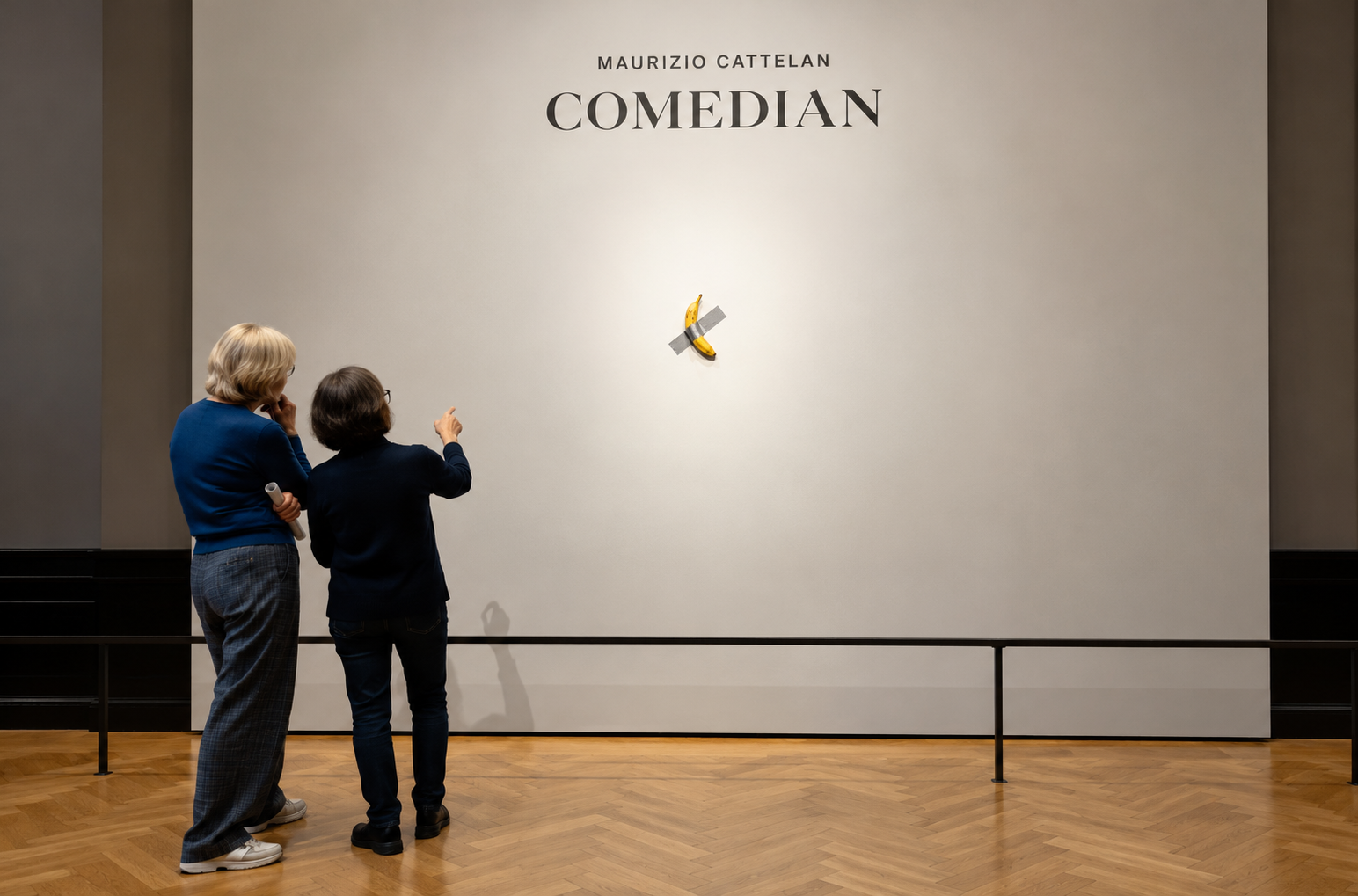
In 2019, Maurizio Cattelan taped a banana to a wall and called it Comedian. In November 2024, one edition of the work sold for $6.24 million. It would be difficult to regard the mere use of an ordinary object as an artistic discovery. Duchamp had taken care of that particular question long ago. Cattelan, however, did something rather more mischievous. He mocked the mechanisms through which the art world assigns value, and the art world obligingly provided a spectacular demonstration of exactly what he meant.
The artist made a joke about the market. The market made money from the joke. And the public was left wondering who, exactly, had the last laugh. Meanwhile, the banana continued to ripen peacefully.
This is a special case because the fourth N does not merely influence the price and reputation of the work; it becomes part of its meaning. Without all the media attention and market excitement surrounding it, Cattelan’s provocation would not have worked in quite the same way. Imagine an identical banana taped to a wall by an unknown artist at a small local exhibition. Would anyone give it more than a passing glance? And yet the banana itself would be exactly the same. Possibly even riper.
Which brings us to a much more interesting question than whether a banana can be considered art: how much does an artist’s reputation influence our judgement of a work before we have even looked at it?
Take Zachęta, Poland’s National Gallery of Art in Warsaw. It is an institution of enormous importance to Polish artistic life, with its own history, achievements and every right to take risks. It should exhibit new, controversial and unexpected work, sometimes even work that meets with widespread incomprehension. If it showed only art whose value had already been confirmed by everyone, it would soon become more of a warehouse of established opinions than a place for artistic exploration.
But Zachęta is not an office issuing certificates of artistic excellence. The same goes for Tate, MoMA or any other institution whose name alone can lend an object a particular significance. Exhibiting a work is a curatorial decision. It may be perceptive, courageous or groundbreaking, but it may also turn out to be wrong. Institutions, after all, have the right to make mistakes, although some give the impression that they would rather not exercise that right.
And yet we sometimes behave as though someone more knowledgeable has already checked everything on our behalf. If a work has made it into an important gallery, all that remains is to stand in front of it looking suitably thoughtful. Preferably with your head tilted slightly to one side. That always suggests a particularly intense process of interpretation is underway.
But we can understand an artist’s intentions, appreciate a curator’s choice, read every word of the accompanying explanation, and still think the work is weak. There is no contradiction in that. And the issue goes beyond our right to criticise. The fourth N makes us ask who gets the opportunity to convince us in the first place.
Not all works of art begin their journeys under equal conditions. Some have the support of galleries, critics, collectors and institutions from the outset. Others remain outside those circles, even though their creators may have equally interesting ideas. If that is the case, then when we visit an exhibition, we are seeing more than the results of artists’ efforts. We are also seeing the outcome of an entire series of earlier decisions: who was noticed, who was trusted, who was invited, and whose work was considered worthy of the space.
.And this is where Williamson’s approach begins to work in both directions. We can use the first three N’s to examine what a work is actually offering us, while the fourth helps us understand why that particular work is standing in front of us. This is not about being suspicious of everything that has achieved recognition. It is about remembering that reputation is part of the story of art, but it should never do the looking for us.
Which brings me back to Signer’s red buckets. At first, I saw very little in them. It was only after learning how Sand Column worked that my assessment changed. I understood the idea, recognised the consistency of its execution, and discovered a certain kind of absurd humour. I do not have to consider it a masterpiece to acknowledge that my first impression was incomplete.
I am still less convinced by Jesi Cook’s bucket. I recognise the artistic intention and can place the performance within the tradition of experimental dance, but the fragment I watched did not offer enough to make me consider it particularly successful. Perhaps the full performance would change my mind. Perhaps it wouldn’t. I have no intention of pretending to be impressed just to be on the safe side.
The three N’s will not give us a universal recipe for a good work of art. Nor will the fourth allow us to calculate exactly how much of an artist’s success comes from talent, how much from reputation, and how much from luck. But they can open up some new questions about the quality of artistic ideas, the way those ideas are realised, and the meaning they can genuinely generate. And questions about the mechanisms that allow some works to find an audience while others never receive the same opportunity.
.So perhaps before our next moment of artistic admiration, we should ask not only what the artist has shown us, but also why this particular artist was given the chance to show it. And whether somewhere, beyond the spotlight, there might be someone with far more to say. Someone who simply never had the gallery door opened for them. Not even with a bucket.