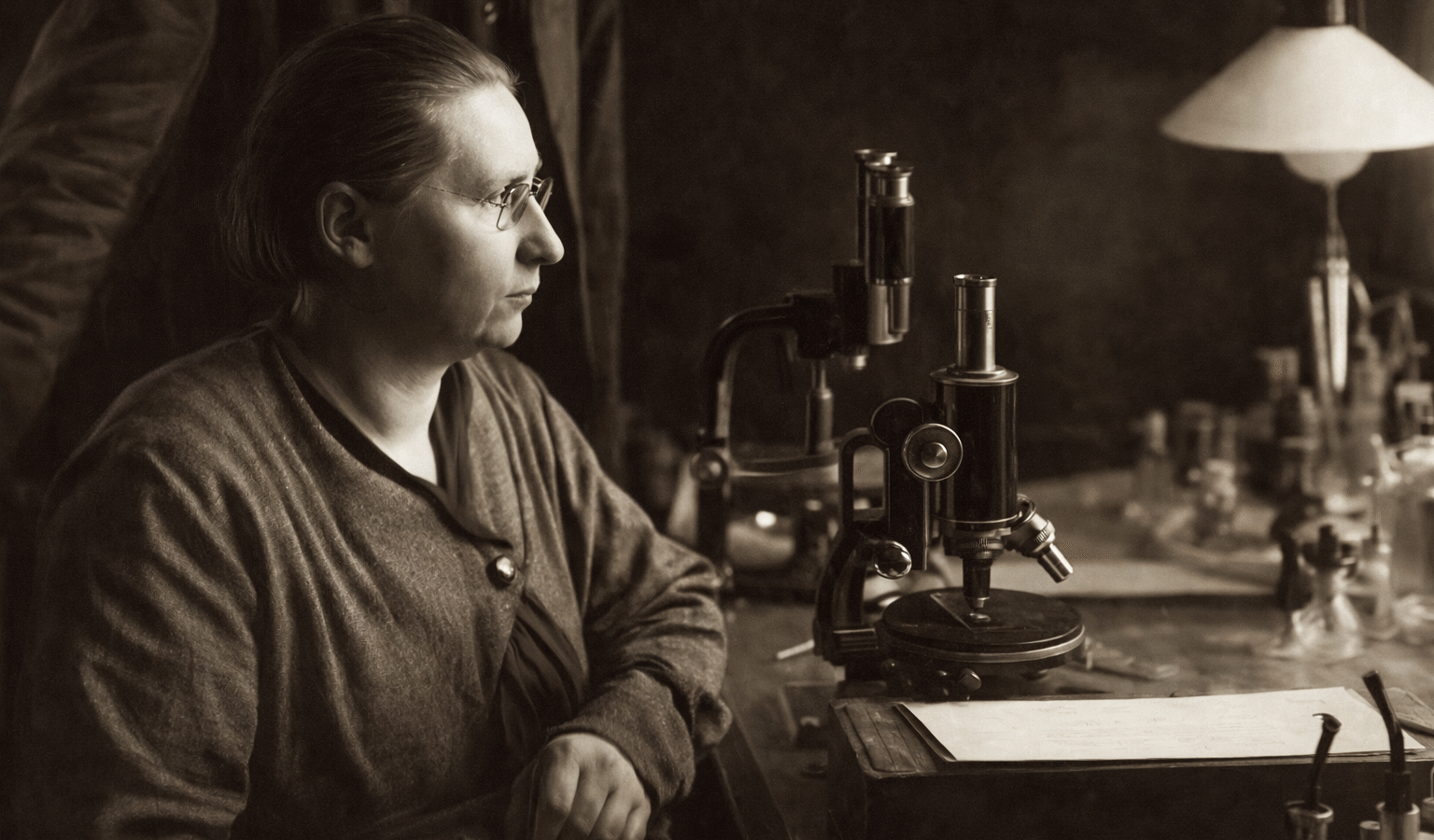
 Helena Krzemieniewska – a pioneer of microbiology in Wrocław



Jolanta PAWNIK
At the age when most people think about retiring, she was embarking on a fresh start. Helena Krzemieniewska was 67 when she obtained her doctorate and started to build a scientific life in the post-war Wrocław.
.Helena Józefa Krzemieniewska was born on March 13, 1878, in Lachowo, in what is now Belarus, into a landed gentry family, the Choynowskis. In a way that was quite progressive for the era, her parents decided to educate their daughter according to her passions. After graduating from Jadwiga Sikorska’s prestigious girls’ school, she continued her studies in 1894–1896 at the Adrian Barniecki Higher Courses for Women in Kraków. At the time, it was one of the few places where women could receive an education that opened the door to university-level study. Starting in 1896, Helena attended lectures as a non-degree student at the Faculty of Mathematics and Natural Sciences of Jagiellonian University. She was a trailblazer – one of the first women to step into the academic sphere.
At the university, Helena took on volunteer work at the Biological and Botanical Institute under Professor Emil Godlewski. There she met Seweryn Krzemieniewski, a botanist who became both her husband and her research partner. Their collaboration was remarkable, as it was grounded in shared research and daily work in the laboratory, yet for many years it did not translate into equal academic standing. Although she conducted research alongside her husband, within the scientific community Helena was largely seen as his assistant.
The spouses dedicated their scientific efforts to the world invisible to the naked eye. They were fascinated by soil microorganisms, slime moulds, and bacteria. Today we understand just how vital life hidden in the soil is, but at the turn of the twentieth century, it was still largely uncharted territory. The Krzemieniewskis were among the pioneers in this field. Their work – including the series Miksobakterje Polski (Myxobacteria of Poland) – became an important point of reference for the emerging discipline of soil microbiology. Krzemieniewskis visited scientific centres across Europe, where they learned the newest trends and methodologies in biology. That exposure allowed them to include in their research approaches that were only just beginning to take root in Poland.
Their personal life was anything but calm, shaped as it was by two wars. During World War I, Helena worked as a nurse, helping to combat outbreaks of smallpox and typhus. In 1920, she was finally able to make her mark on the scientific world as an independent researcher. She was appointed Deputy Professor of Botany at Lviv Polytechnic and supported the research conducted by her husband at Jan Kazimierz University.
During World War II, Helena remained in Lviv, where she worked at Professor Rudolf Weigl’s Institute for Louse-Borne Typhus and Virus Research. It was a unique place where many scientists struggled to survive the occupation, combining research with the daily fight for safety. Krzemieniewska worked there as a lice feeder, sustaining insects used in experimental studies.
After the war, Helena returned to Kraków, where she immediately earned her doctoral degree – a feat she accomplished at the age of 67. It was a poignant moment, coming just after the death of her husband, with whom she had shared both her life and her scientific work for decades. Despite this personal loss, she chose to carry on with her research and take on new challenges.
For this new chapter, she chose Wrocław, where established scholars were welcomed with open arms. In 1946, she was appointed full professor at the University of Wrocław and set up the Chair of Plant Physiology – her first independent academic post.
Krzemieniewska spent twenty active years in Wrocław, conducting research, teaching courses, and training students. She was also involved with other institutions, including the Agricultural University and the Polish Academy of Sciences.
Helena remained committed to her research interests to the very end of her life. Her work centered on soil microorganisms, particularly slime moulds. In 1960, she published the monograph Śluzowce Polski na tle flory śluzowców europejskich (Slime Molds of Poland in the Context of the European Myxomycete Flora), a study that both systematized existing knowledge and reflected the scope of her decades-long work. One of Krzemieniewska’s most important scientific achievements was demonstrating that the process of binding free nitrogen in the soil involves not only bacteria but also inorganic substances. To this day, some scientific names of organisms include the abbreviation ‘Krzemien.’, indicating her authorship of their description. A species of bacterium was named in her honour: Cytophaga krzemieniewskae Stanier.
.As her colleagues recalled, Helena wasn’t interested in fame and dedicated herself to her research and students. She remained an active member of the Polish Botanical Society, the Polish Microbiological Society, and the Wrocław Scientific Society until the end of her life. She died on May 28, 1966, in Wrocław at the age of 88. She was laid to rest at St. Lawrence Cemetery, alongside other professors who helped build Wrocław’s academic community after the war. Her daughter, Zofia Jadwiga, was a chemical engineer.