 The Epidemic That Sealed Wrocław Off from the World



Jolanta PAWNIK
‘In the summer of 1963, Wrocław was placed under a sanitary cordon, and its inhabitants became part of one of the largest vaccination campaigns carried out in post-war Europe. The smallpox epidemic was the only outbreak of the disease in the history of the Polish People’s Republic and one of the last in Europe before its complete eradication,’ writes Jolanta PAWNIK
.The epidemic of smallpox (Latin: variola vera), also known as black smallpox, was officially declared on 17 July 1963, although it had begun much earlier. In May that year, Security Service officer Bonifacy Jedynak returned to Poland from Asia. A few days later, he was admitted to hospital on Ołbińska Street with a high fever and a rash. Doctors diagnosed malaria, and tests did indeed confirm the presence of malaria parasites. No one realised that he was also infected with the smallpox virus. After a few days, he left the hospital, having infected just one person: the cleaner responsible for his isolation ward. She became the source of subsequent infections. Although she developed only a mild form of the disease, she passed it on to both her daughter and her son, who died. The doctor she consulted also lost his life.
Over the following weeks, doctors struggled with a disease they were unable to identify. They suspected chickenpox, other infectious diseases and even leukaemia. The breakthrough came only after Dr Bogumił Arendzikowski of the Municipal Sanitary and Epidemiological Station analysed the successive cases. On 15 July – later known as ‘Black Monday’ – the correct diagnosis was finally made, and two days later the epidemic was officially declared. By then, forty-seven days had passed since the first case.
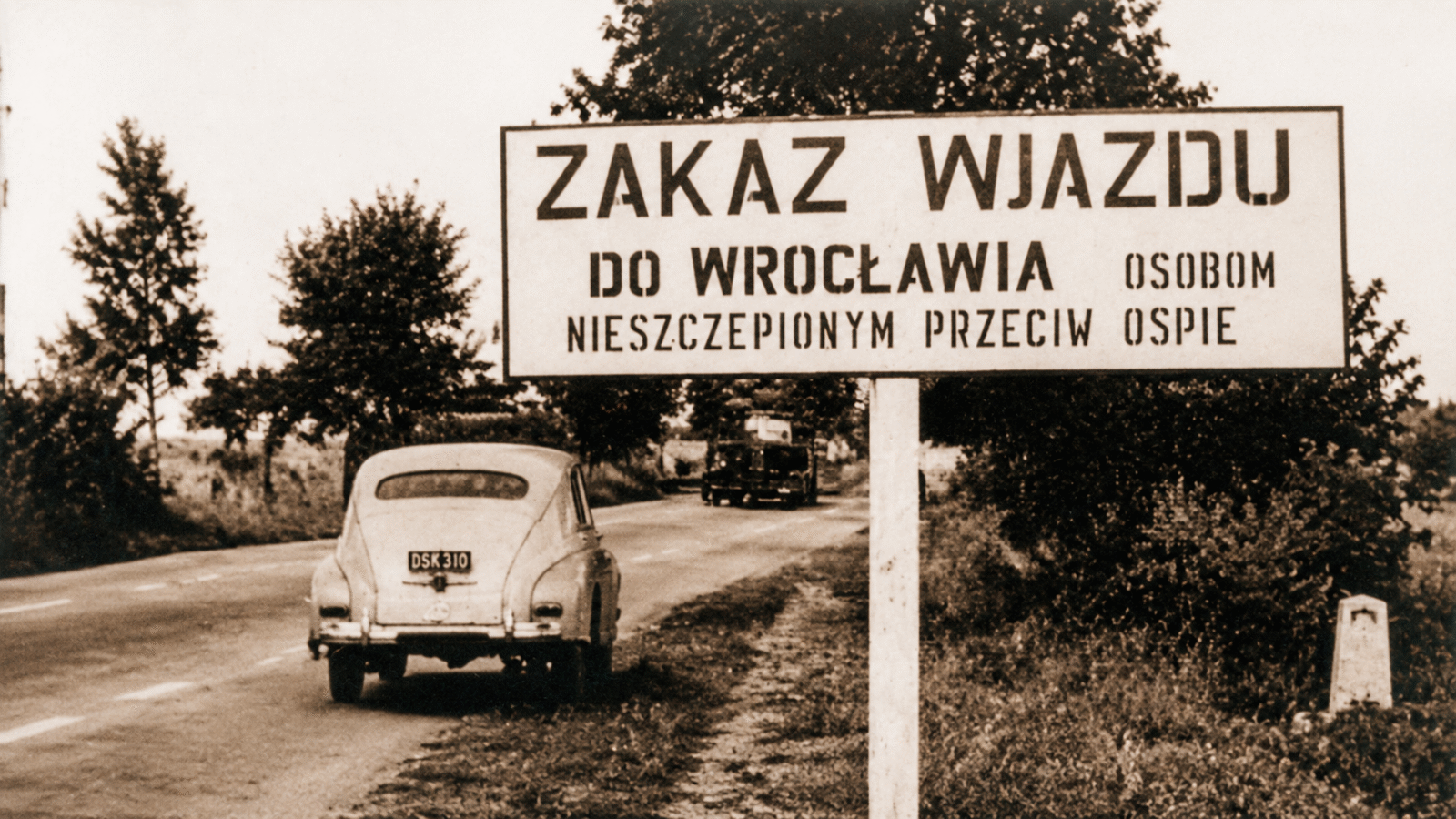
Wrocław changed almost overnight. Police and sanitary checkpoints appeared on the roads leading out of the city. Residents could leave only on presenting a vaccination certificate; those who had not been vaccinated were directed to vaccination centres. Similar checks were introduced at railway stations, where travellers without the required documents were refused tickets. Bathing areas were closed, the sale of drinks from street soda-water dispensers was suspended, and a few weeks later even self-service bread sales were halted for fear that the virus might spread through touch. Despite the exceptionally hot summer, swimming pools remained closed. The borders between the then Wrocław Voivodeship and Czechoslovakia and the German Democratic Republic were closed to tourist traffic.
The appearance of the city also changed. Door handles in offices, railway stations and other public buildings were wrapped in gauze soaked in chloramine. Containers filled with disinfectant were placed at entrances, where people were expected to disinfect their hands and footwear. Posters appeared across the city bearing the slogan: ‘We greet and bid farewell without shaking hands.’ This brief appeal perfectly captured the atmosphere of those days, when caution became part of everyday life.
The greatest challenge was tracing everyone who might have come into contact with an infected person. Detailed lists of first- and second-degree contacts were compiled, and those at risk were sent to isolation centres. These were established, among other places, in Pracze Odrzańskie and Psie Pole, while a hospital for patients was organised in Szczodre. In total, more than 1,400 people were placed in isolation, and over eight million people across Poland were vaccinated, including around two million in Lower Silesia. In Wrocław alone, nearly 98 per cent of residents received the vaccine. The operation remains one of the largest epidemiological undertakings ever carried out in Poland.
This did not mean, however, that life in the city came to a complete standstill. The people of Wrocław continued to go to work, children enjoyed their summer holidays, and public transport kept running, although every journey was accompanied by a sense of uncertainty. Particularly alarming was the news that a tram driver working on the route between the city’s main railway stations had fallen ill.
The climate of fear fuelled rumours and false reports. Stories circulated of people dying in the streets, crematoria being built at isolation centres, and even a mysterious circus was said to have brought the disease to the city. These stories were largely untrue, yet, similar to the rumors during the COVID-19 pandemic, they illustrated the rapid dissemination of fear during a crisis.
Doctors, nurses, public health officials and support staff played a vital role in dealing with the epidemic. They worked in isolation centres, conducted epidemiological investigations, organised vaccinations and cared for the sick, often putting their own health at risk. Four of the seven people who died during the epidemic were healthcare professionals. One of its most distinguished figures was Dr Alicja Surowiec, who headed the smallpox hospital in Szczodre – after the epidemic had ended, she was voted television’s ‘Person of the Year 1963’.
Although the World Health Organization predicted that the epidemic might last as long as two years and result in around two thousand cases, reality proved very different. Thanks to the swiftly organised vaccination campaign and an effective isolation system, only 99 people fell ill and seven died. The last infection outside the isolation centres was recorded on 10 August, and on 19 September 1963 Wrocław was officially declared free of smallpox.
.The Wrocław epidemic went down in history not only because of the efficiency with which it was brought under control. It proved to be one of the last outbreaks of smallpox in Europe before the disease was eradicated worldwide. The World Health Organization officially declared smallpox eradicated seventeen years later, in 1980. To this day, it remains the only infectious human disease to have been completely eradicated.