 The Congress That Put Wrocław in the World Spotlight



Jolanta PAWNIK
‘It was intended to showcase post-war Wrocław and bring together leading figures from the worlds of culture and science in defence of peace. Instead, it ended in political conflict, the demonstrative departure of some participants and a dispute over whether those gathered in the auditorium of Wrocław University of Science and Technology were genuinely defending peace or taking part in one of the first major propaganda operations of the Cold War. The World Congress of Intellectuals held in August 1948 remains one of the most remarkable international events in Wrocław’s post-war history’, writes Jolanta PAWNIK
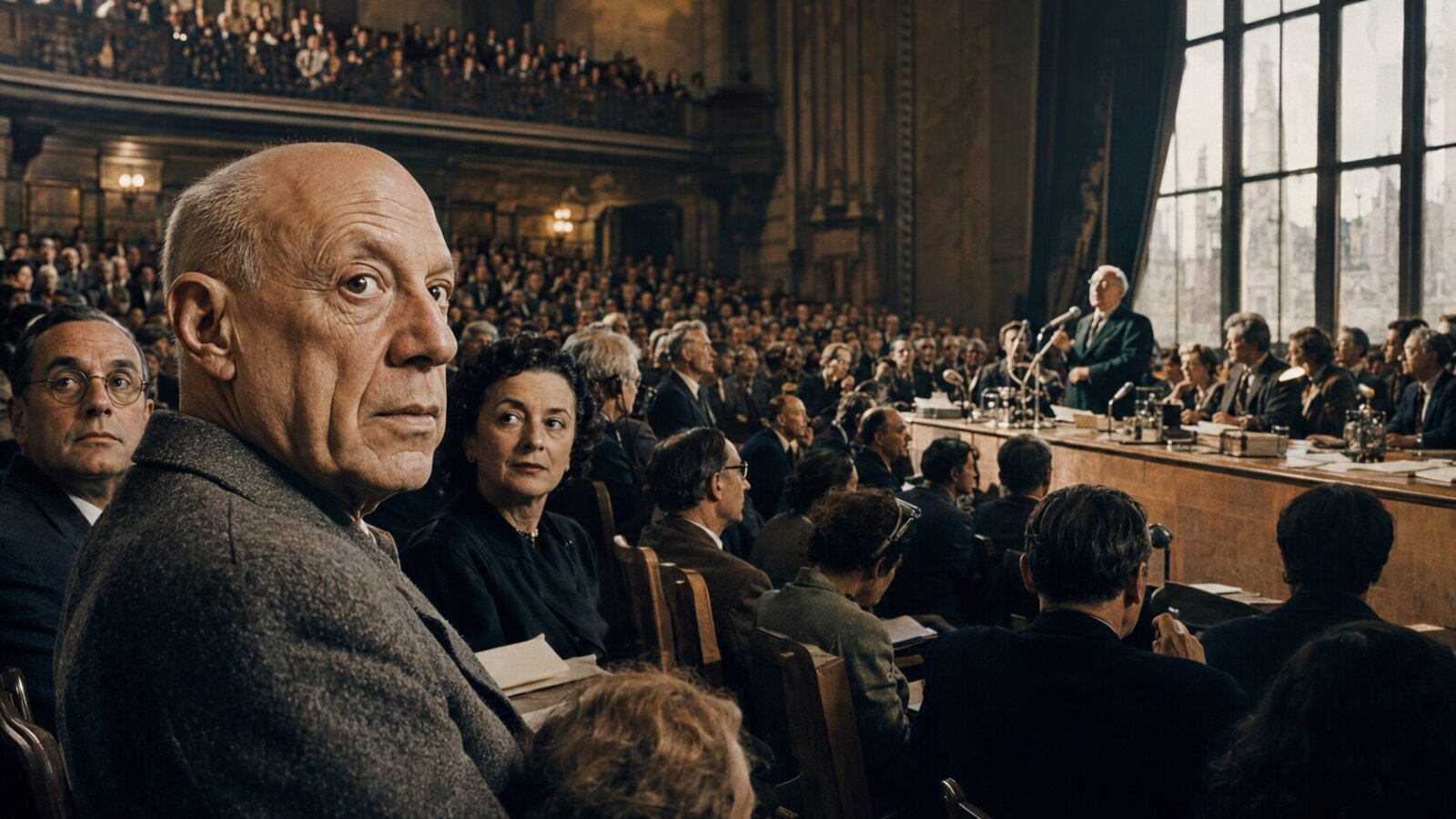
.Nearly eighty years later, the list of those who attended the Congress continues to impress: Pablo Picasso, Bertolt Brecht, Irène and Frédéric Joliot-Curie, Fernand Léger, Paul Éluard, Julian Huxley, Mikhail Sholokhov, Ilya Ehrenburg, Zofia Nałkowska, Maria Dąbrowska, Julian Tuwim, Antoni Słonimski, Tadeusz Kotarbiński, Ludwik Hirszfeld and Hugo Steinhaus. Albert Einstein, though not actually present, sent a special message to the participants. For four days, from 25 to 28 August 1948, Wrocław hosted several hundred representatives of science, culture and the arts from 46 countries.
The World Congress of Intellectuals in Defence of Peace was an unprecedented undertaking in the then brief history of Polish Wrocław. The city was only just beginning to recover from the devastation of the war when it hosted the Exhibition of the Recovered Territories, a major state-organised event was designed to showcase the achievements of the first post-war years and affirm the Polish character of the territories incorporated into Poland after the war. The Congress was intended to give its message an international dimension. “Look at these ruins! Could the Peace Congress have asked for a more fitting backdrop?” French writer Maurice Bedel drew attention to the stark contrast between the idea of peace and a cityscape still bearing the scars of the recent war.
Jerzy Borejsza, one of the most influential figures in post-war cultural life and later the Congress’s secretary-general, is most often credited with initiating the event. It is unclear, however, to what extent the idea was truly his; historian Krystyna Kersten considered it unlikely that such an undertaking could have emerged independently of broader Soviet plans to create an international peace movement.
Preparations were handled by Polish and Polish-French committees whose members included Irène and Frédéric Joliot-Curie, Le Corbusier, Maria Dąbrowska, Zofia Nałkowska, Xawery Dunikowski, Tadeusz Kotarbiński and Jan Parandowski. The organisers drew on the pre-war tradition of international writers’ congresses held in defence of culture.
At the same time, they carefully avoided symbolism that might give the gathering an explicitly communist character. The formula was intended to be as broad as possible, while prominent names were meant to enhance the event’s international standing. From the organisers’ perspective, bringing figures such as Picasso or UNESCO’s first Director-General Julian Huxley to Wrocław was a major success.
The Congress met in the auditorium of Wrocław University of Science and Technology. The Polish delegation, headed by Jarosław Iwaszkiewicz, was an impressive one: alongside writers, it included eminent scholars such as Ludwik Hirszfeld, Tadeusz Kotarbiński, Stanisław Ossowski and Kazimierz Ajdukiewicz.
At first, proceedings were relatively calm. Everything changed with a speech by Alexander Fadeyev, chairman of the Union of Soviet Writers and head of the Soviet delegation. He accused the West of preparing another, claiming that “the shackles of the American imperialists are intended to turn the world into a police station and its people into slaves of capital.” His attack on Western writers caused even greater outrage: “If jackals could learn to type, if hyenas could wield a pen, what they produced would surely resemble the books of the Millers, Eliots, Malraux and other Sartres.”
The reaction of some Western intellectuals was fierce. “The task of intellectuals is to preach tolerance and understanding, not hatred. Yet what is being preached here is war, not peace,” replied Oxford historian A. J. P. Taylor, who also protested against the comparison of American democracy with fascism.
The atmosphere deteriorated by the hour. When Western delegates spoke, Fadeyev reportedly made a show of removing his translation headphones. Some British and American participants considered withdrawing from the Congress, and Taylor and Huxley eventually left Wrocław. “For the Poles, the tone set by the Russians was a disaster,” journalist François Bondy commented years later. In his view, the Polish organisers had seen the Congress as an opportunity to maintain contacts with the Western world, whereas the speeches by the Soviet delegation only deepened the divisions between intellectuals on either side of the Iron Curtain.
Of all the participants, Pablo Picasso attracted the greatest attention. According to one account, his journey to Poland was his first trip by air. The artist arrived on a specially arranged flight and delivered a speech in defence of the Chilean poet Pablo Neruda, calling for an end to his persecution and the lifting of censorship.
Picasso remained in Poland after the Congress and later visited Warsaw, where Bolesław Bierut decorated him with the Order of Polonia Restituta. His time in Wrocław also left a more enduring legacy: his famous drawing of the dove of peace and a figure featuring the distinctive bird, which he drew on the wall of a flat in the Kościuszko housing estate. Both became part of the history of the Exhibition of the Recovered Territories.
Foreign visitors were kept under surveillance by the security apparatus. Guides assigned to individual groups were expected to prepare reports on the delegates’ whereabouts, statements, contacts and opinions of the Congress. Profiles of participants and their views were also compiled. Thus, while the auditorium hosted discussions about the free development of culture and cooperation between nations, outside it the security services were gathering information on the foreign intellectuals attending the event.
More mundane difficulties also emerged. Jan Parandowski later complained about lengthy speeches, poor-quality interpreting and a “linguistic chaos” that made genuine discussion virtually impossible. On one occasion, the British delegation was refused entry to the auditorium. A photograph of the British delegates sitting on the steps of Wrocław University of Science and Technology later appeared in the Italian press.
The Congress also had its own publication, a special periodical entitled In Defence of Peace. Four issues were published, three of them during the Congress itself. Among those documenting the event was Julia Pirotte, a photographer known for her work chronicling the French Resistance in Marseille.
Despite the tensions, the Congress continued. However, the Soviet delegation was forced to soften its previously drafted final resolution, as the original version stood no chance of winning broad support. In the document ultimately adopted, the participants declared: “We raise our voices in defence of peace, in defence of the free cultural development of nations.” The resolution was supported by 371 of the 391 delegates. Opposition came primarily from the delegations of the countries most heavily attacked during the Congress, the United Kingdom and the United States.
For the communist authorities, the very fact that several hundred prominent figures from the worlds of science and culture had come to Poland was a success. At the same time, the Congress demonstrated how difficult it was to maintain its professed apolitical character at a moment when the post-war alliance of the victorious powers was visibly falling apart. By 1948, the Soviet blockade of the Western sectors of Berlin was already under way, relations between Moscow and Washington were rapidly deteriorating, and the United States remained the only country in possession of atomic weapons.
In such circumstances, the slogan of “defending peace” acquired a meaning that went far beyond the intellectuals’ professed concern for the future of the world. “This Congress is merely proof that Russia does not yet have the atomic bomb,” Maria Dąbrowska commented. In her assessment, Moscow was trying to use the peace movement to weaken the West’s readiness while continuing to build up its own military capabilities.
.What happened in the auditorium of Wrocław University of Science and Technology can be seen as a snapshot of a world in transition: people who had come to discuss peace quickly discovered that they were already standing on opposite sides of an emerging Iron Curtain.