 Ignacy Feliks Dobrzyński - A Remarkable Talent






Ewa BOGULA-GNIAZDOWSKA
The only tangible trace of a link between the two composers is Dobrzyński’s Funeral March on the Death of Fryderyk Chopin, Op. 66, composed after Chopin’s death as an act of homage.
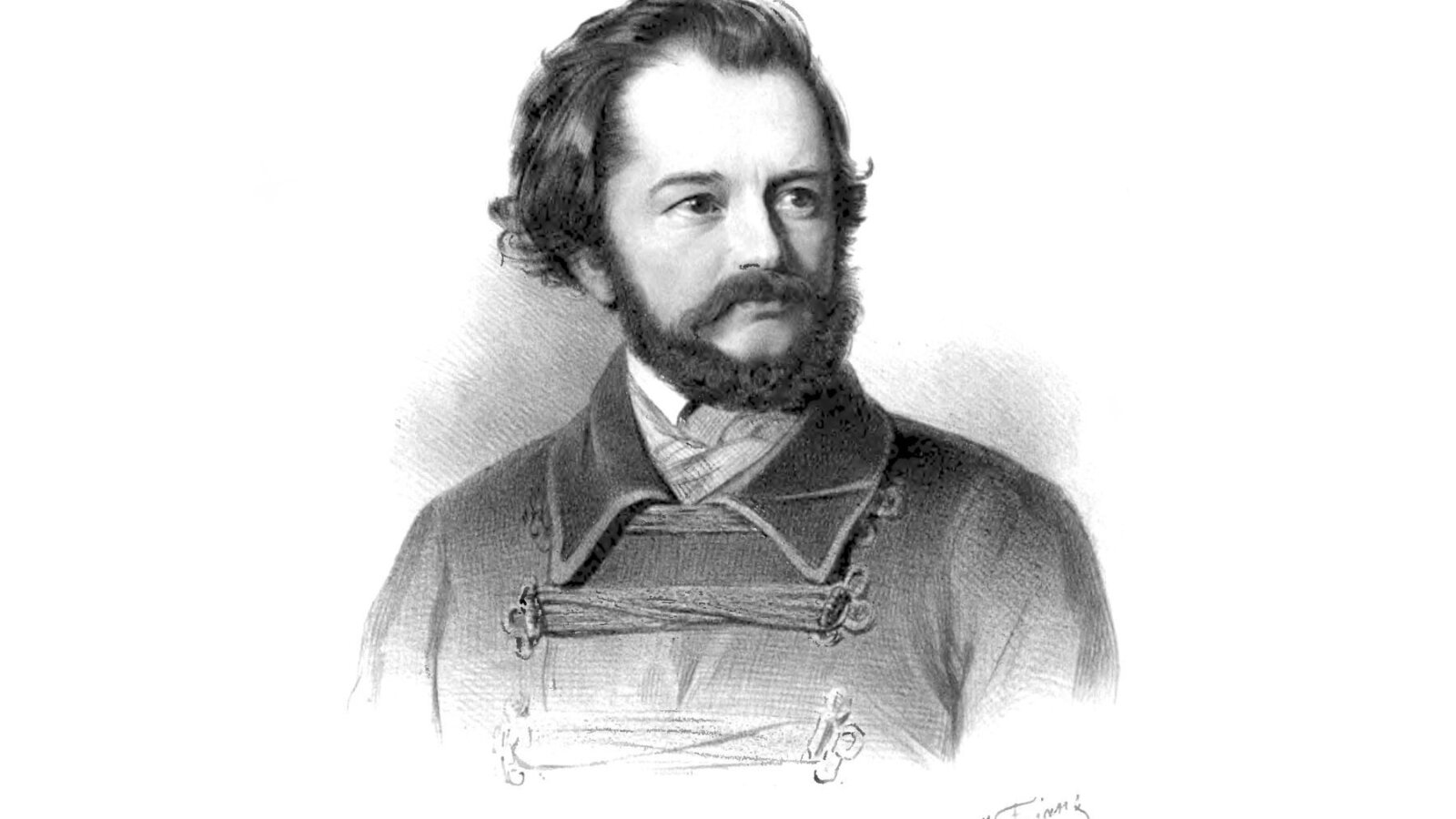
.Ignacy Feliks Dobrzyński – pianist, pedagogue, conductor and one of the foremost Polish symphonists of the first half of the nineteenth century – was also a schoolmate of Fryderyk Chopin, in whose shadow he has long remained. Dobrzyński was born in 1807 in Romanów, Volhynia, where he began his musical journey. Later, like Chopin, the young Ignacy continued his musical education in Warsaw under Józef Elsner.
In 1825, Dobrzyński came to Warsaw and started private consultations with Elsner. The subsequent year, he enrolled in the Main School of Music, continuing his studies under Elsner’s guidance. His collaboration with the professor must have been highly successful, as evidenced by Elsner’s outstanding assessment of his pupil’s progress, recorded after the first examination on 17 July 1827, succinctly described as ‘remarkable talent’.
Regrettably, we have no information regarding Dobrzyński’s relationship with his schoolmate, Fryderyk Chopin. It is certain that both attended the Main School of Music at the same time and were therefore acquainted, and it seems likely that they had opportunities to become familiar with each other’s work. However, no correspondence between them has survived, nor are there other sources that might shed light on the nature of their relationship. Any speculation about closer personal or artistic ties must therefore remain conjectural. The only tangible trace of a link between them is Dobrzyński’s Funeral March on the Death of Fryderyk Chopin, Op. 66, composed after Chopin’s death as an act of homage.
Let us return, then, to Dobrzyński himself and the beginnings of his artistic career. When the eighteen-year-old composer came to Warsaw for his first meeting with Elsner, he reportedly presented two remarkable early compositions: the Concert Overture in D major, Op. 1, and the Piano Concerto in A-flat major, Op. 2. These pieces were most likely composed in Vinnytsia, where Dobrzyński lived with his family prior to settling in Warsaw. They may be seen as his intended artistic calling card – a means of announcing himself and securing a confident entry onto the city’s concert stages.
The latter of the two works occupies a place of no small importance in the history of Polish music. Composers seldom opted for the piano concerto in the early nineteenth century, despite the generally high artistic quality of the surviving works. Apart from Dobrzyński and Chopin, only a handful of composers in Poland were writing piano concertos at the time, among them Feliks Janiewicz, Franciszek Lessel, Józef Deszczyński, Wojciech Sowiński and Józef Krogulski. What is more, all indications suggest that Dobrzyński’s concerto was composed a few years earlier than the now universally celebrated concertos in E minor and F minor by his famous contemporary.
Ignacy Feliks Dobrzyński’s Piano Concerto in A-flat major, Op. 2, likely reflects the significant impact of the prevalent style brillant among Polish composers around the turn of the nineteenth century. As is well known, Polish pianists were familiar with the concert works of Ignaz Moscheles, Ferdinand Ries and Johann Nepomuk Hummel, and drew inspiration from their music. This turn towards the style brillant led, in the first three decades of the century, to a revival of the classical tradition and to a flowering of virtuoso means. Concertos in the style brillant were characterised above all by the use of virtuosic elements and the display of bravura, with a relatively modest role assigned to the orchestra. This should not be taken to suggest that Polish piano concertos of the period relied exclusively on bravura; rather, they combined formative elements of virtuosity with lyricism and classical influences.
Dobrzyński’s Piano Concerto in A-flat major, Op. 2, is among the most skilfully orchestrated Polish concertos from the early phase of the genre’s development. The composer’s experience of working with larger instrumental forces was no doubt a significant factor. His assured handling of the orchestra may have resulted not only from the parallel study of piano and violin undertaken in his earliest years under his father’s guidance but also from his sustained, close contact with an orchestral ensemble in Romanów, where his father, Ignacy, served as director of the orchestra at Count Iliński’s residence. As the composer’s son, Bronisław Dobrzyński, recorded in the first monograph devoted to his father (1893), ‘he would often step into the circle of players during rehearsals and observe each instrument individually with great enthusiasm, showering the performers with questions and avidly absorbing the sound of each instrument, its character, purpose and technique’. It is worth noting that Count Iliński was the very person through whom Dobrzyński sought, years afterward, to secure authorisation for dedicating his composition to Tsar Nicholas I. In a letter dated 9 June 1828, he wrote: ‘I humbly request Your Excellency to procure the consent required for me to offer the first fruit of my musical labour, my first concerto, as a dedication to His Imperial Majesty.’ Such requests were common practice at the time, as composers hoped that permission to dedicate a work, for instance to the reigning monarch, would enhance their standing and help secure wider circulation for the piece. In Dobrzyński’s case, these efforts were evidently unsuccessful, since the work was neither performed nor published during his lifetime.
The Piano Concerto in A-flat major is laid out in three movements: Allegro moderato, Andante espressivo and a final Rondo. Vivace, ma non troppo. The second movement (Andante espressivo) is particularly striking, not least for its use of a kind of recitative built over a fixed, recurring rhythmic pattern in the orchestra. This inevitably calls to mind a comparable recitative, set against a tremolo backdrop, in the Larghetto of Chopin’s Piano Concerto in F minor, Op. 21. Such coincidences, together with other musical affinities between the two works, led some listeners and scholars to suggest that Chopin may in fact have drawn inspiration from Dobrzyński’s slightly earlier composition, or even that Dobrzyński took part in the orchestration of Chopin’s concertos.
The truth of what happened is difficult to establish today. However, a more likely explanation is that there were shared musical solutions from which both Dobrzyński and Chopin might have drawn. As models for both composers – and for the slow movements of their concertos in particular – one might point to analogous passages in Ignaz Moscheles’s Piano Concerto No. 3 in G minor or Ferdinand Ries’s Piano Concerto No. 3 in C-sharp minor from 1812.
What matters in the context of the reception of Dobrzyński’s work, and of any potential influence it may have exerted on Chopin, is the fact that the Piano Concerto in A-flat major, Op. 2, was in all likelihood never performed in its complete form during the lifetime of either composer. There were certainly semi-private performances at the time, for instance with a chamber-sized orchestral ensemble and a soloist. Such pre-première showings were, after all, common practice in Warsaw for Chopin’s concertos as well. Although Chopin’s Piano Concerto in F minor received its first official public performance only on 17 March 1830 at the National Theatre, this première was preceded by two semi-private trials – one in February of that year and another in early March, when the Chopin family salon reportedly brought together the musical elite of Warsaw, including Józef Elsner, Karol Kurpiński and Wojciech Żywny. On that occasion, the orchestral part was realised in chamber forces, with the composer himself, of course, at the piano.
If we assume that the surviving sources are complete, the public had to wait no fewer than 162 years for the official première of Dobrzyński’s Piano Concerto in A-flat major, Op. 2. Fortunately, an almost complete manuscript of the work in the composer’s own hand – a musical autograph – has survived, making it possible, albeit after a long delay, to bring the concerto to performance. The first modern public première of the work (in the version prepared by Kazimierz Rozbicki) took place on 10 September 1986 at the 20th Polish Piano Festival in Słupsk. Paweł Skrzypek took the stage as the soloist, accompanied by the Słupsk Chamber Orchestra under the direction of Zdzisław Siadlak. The concerto was recorded for the first time by Jerzy Sterczyński with the Rzeszów Philharmonic Symphony Orchestra.
Today, we can enjoy further recordings of the work. In recent years, Howard Shelley, for example, has returned to the concerto. He prepared his own revision of Krzysztof Rozbicki’s edition, which led to a performance under his direction and a recording of the concerto by Philippa Giusiano with Sinfonia Varsovia, recorded and released by the Fryderyk Chopin National Institute in 2020.
.Dobrzyński’s remarkable work may also be explored through an exceptional book publication. A limited, hand-numbered facsimile edition of the manuscript – an attempt to reproduce the original source as faithfully as possible in printed form – of Ignacy Feliks Dobrzyński’s Piano Concerto in A-flat major, held in the collections of the Warsaw Music Society, has recently been published by the Fryderyk Chopin National Institute. We hope that both the recordings and the composer’s autographs will appeal to admirers of nineteenth-century Polish music. What truly matters in musical appreciation is not the historical order of musical works, but a composition’s ability to stir our emotions and resonate with our inner selves. We believe that the concertos of both Chopin and Dobrzyński already hold – or may yet come to hold – an important place in your musical library or virtual playlist.