 The History of Fryderyk Chopin’s Heart





Artur SZKLENER
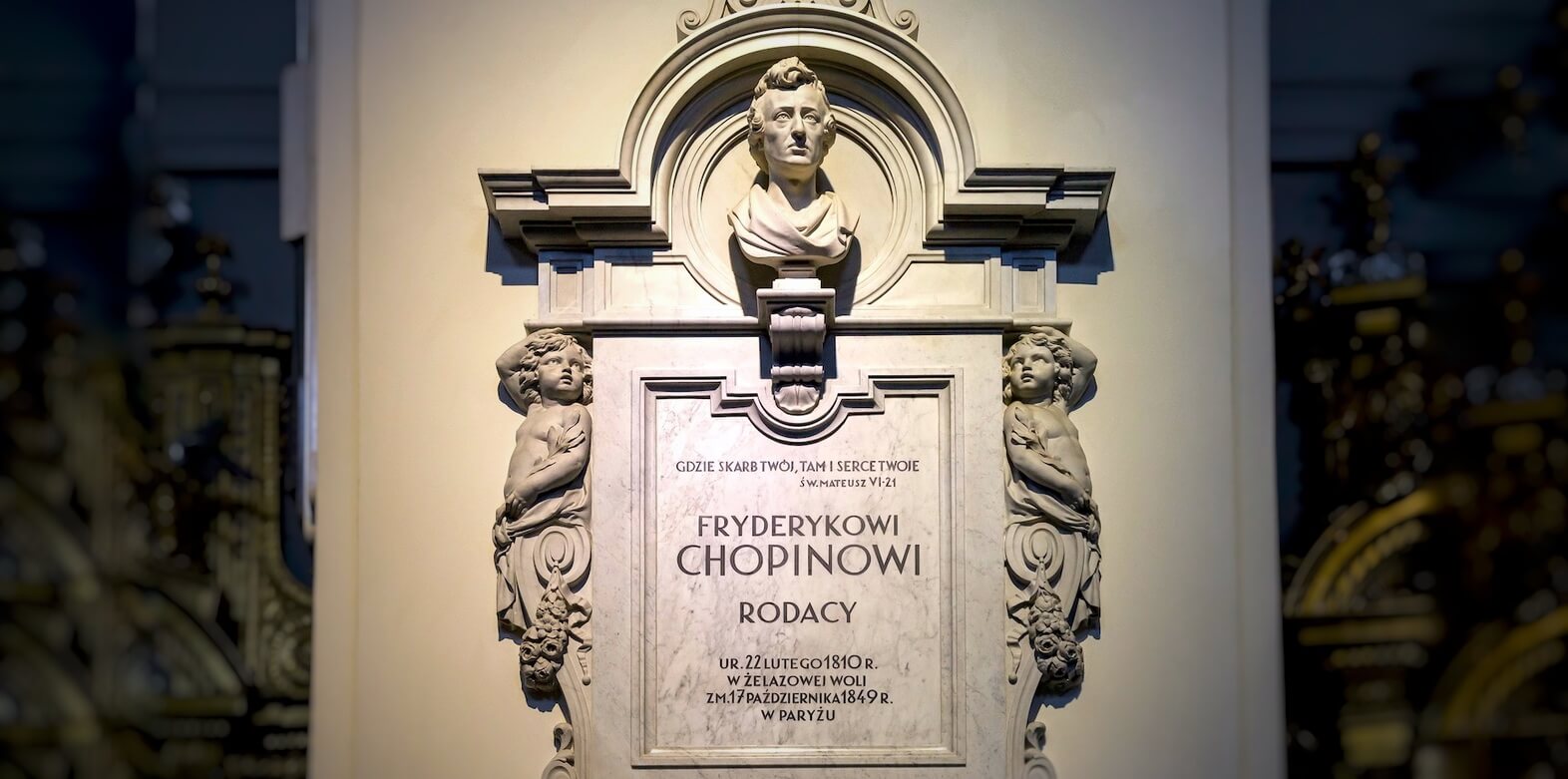
In 1879, on the 30th anniversary of Chopin’s death, the Warsaw Music Society arranged for the urn holding his heart to be entombed in the first pillar to the left of the nave at the Church of the Holy Cross. Since then, it has become an unquestioned symbol of Polish national identity.
.Fryderyk Chopin died in Paris on 17 October 1849. His funeral was a deeply mournful event, attended by the city’s elite and artistic circles – over three thousand specially invited guests were present, alongside numerous ordinary Parisians. The funeral procession from the La Madeleine Church to Père-Lachaise Cemetery was led by Prince Adam Czartoryski. During the ceremony, Mozart’s Requiem was performed, which required the consent of the Archbishop and testified to the rank of the occasion – a fact noted even by the Polish press. The piece carried a highly symbolic meaning, as Mozart belonged to the small circle of composers whom Chopin esteemed above all others: he repeatedly pointed to Mozart’s works as an unattainable model. At the same time, the Requiem in D minor had become a kind of Mozart’s artistic and spiritual credo; its performance therefore deepened both the artistic and the religious meaning of the occasion.
In accordance with the composer’s wishes, his heart was then taken to Poland. That wish itself arose from a convergence of circumstances. First of all, Chopin never ceased to regard himself as an émigré. According to Ferenc Liszt, he considered the word “żal” to be the most fitting symbolic expression of his art – a longing sorrow for Poland, for home and for his loved ones, and a grief born of the post-insurrection reality and the impossibility of return. He wanted to be buried at Powązki Cemetery, next to his father and sister, Emilia. Yet, as he remarked, ‘Paskiewicz [Ivan Fyodorovich Paskevich, Russian Viceroy of the Kingdom of Poland in 1832–1856 – A.S.] will not allow my body to be taken to Warsaw, so at least take my heart.’ The second motive was strictly medical. Chopin believed that a serious heart condition lay at the root of his deteriorating health, and he asked that his body be subjected to an autopsy for scientific purposes. For a long time, historians have argued about whether he was afraid of being buried alive, a fear shared by many of his peers. It turned out that the famous French inscription, stating ‘When this cough finally suffocates me, take out my heart, for I do not wish to be buried alive,’ was actually written by his father. Therefore, if such a fear indeed formed part of Chopin’s motives, it remained unexpressed.
The return of Chopin’s heart to his native land was imbued with symbolic significance for Poles right from the beginning. During the composer’s lifetime he had already come to personify the nation – an idealised exile, forced to live abroad. That image entered deeply into Polish patriotic thought and found one of its most compelling expressions in Lviv, where Ignacy Jan Paderewski declared: ‘In him is revealed our entire collective soul.’
The widely circulated story recounts how Chopin’s sister, Ludwika Jędrzejewicz, carried his heart back to Poland, hidden in her dress. Yet there is no firm evidence that this account is true. Its sole source is a recollection by Antoni Jędrzejewicz – the composer’s nephew – written down some fifty years after the events. However, readers of Kurier Warszawski had learned of Chopin’s wish to have his heart returned to Poland already in November 1849. Ludwika came back to Warsaw at the beginning of January 1850, but the newspaper reported the arrival of the heart only two months later, on 17 March: ‘In accordance with the wish of the late Chopin, as we previously informed our readers, his heart left Paris, where the composer’s life has come to an end, and has now arrived on our soil.’ Soon after Ludwika’s return, an official parcel also reached Warsaw. It contained personal mementoes of the composer, entrusted to the family by his pupil and admirer Jane Stirling. According to the transport document, a coffer with a heart was among the items, which suggests that the tale of Ludwika smuggling it in her clothes was a later fabrication. Yet the possibility cannot be entirely dismissed. She may have brought back only the jar itself, leaving the decorative coffer in Paris to be forwarded at a later date by Stirling. Such an action would have been highly risky and against the strict regulations governing the transport of human remains from abroad, but it was not impossible.
In Warsaw, the heart remained for a time in the Jędrzejewicz family home on Podwale Street before being transferred to the Church of the Holy Cross, the Chopin family’s parish church. The parish register from 1791 recorded an interesting fact: it was the first mention of the composer’s father, Mikołaj, staying in the city. He was then eighteen years old, living with his Polish guardians, the Weydlich family, and appeared in the records under the name ‘Mikołaj Szotan’. There is, however, no doubt today that this entry refers to him. It was in this same parish that Fryderyk’s two younger sisters, Izabela and Emilia, were baptised. The church was also the starting point of the funeral procession of Stanisław Staszic – a ceremony that may well have influenced the funeral march composed many years later in Chopin’s Sonata in B flat minor. The site clearly held particular significance for the composer. At the beginning of the nineteenth century it was also the largest church in Warsaw. The remains of Prince Józef Poniatowski, brought from Leipzig, were interred there, which made it an obvious choice for Chopin’s heart resting place.
The precise date on which the heart was moved to the church remains unknown. Antoni Jędrzejewicz recalled that the clergy delayed the matter, objecting primarily to the idea of erecting a monument in the nave to a layman. However, Chopin’s informal relationship with the divorced George Sand may also have contributed to these reservations. Eventually, the heart was placed in the catacombs – a fact recorded in the published sources from 1855, which means the interment must have taken place before that date. Paradoxically, the unassuming manner in which the urn was stored may have saved it from destruction in 1863. In reprisal for a failed attempt on the life of Fyodor Berg, Russian troops not only ransacked nearby apartments – destroying, among other things, Chopin’s piano kept by his younger sister Izabela Barcińska – but also looted the Church of the Holy Cross and desecrated its vaults. It was only on the thirtieth anniversary of the composer’s death, in 1879, that the Warsaw Music Society arranged for the urn to be immured in the first pillar on the left side of the nave, above the crypt.
During a ceremonial charity concert organised by the composer Władysław Żeleński, funds were raised for an epitaph intended for the Church of the Holy Cross. On that occasion Mozart’s Requiem was performed, setting in motion the tradition of presenting the work in this setting. The epitaph itself was installed in the church in 1880. Mozart’s Requiem was heard beneath Chopin’s heart again in 1935, marking the 125th anniversary of the composer’s birth. The ceremony included the unveiling of a new plaque bearing his date of birth as recorded in the baptismal register – 22 February 1810. The original plaque had given the date as 2 March 1809. Today, however, it is generally accepted that Chopin was born on 1 March 1810, which was the day on which the Chopin family celebrated his birthday, and the date he himself provided when applying for membership of the Société Historique et Littéraire Polonaise in Paris. Regular performances of Mozart’s Requiem have formed part of the musical life of the Church of the Holy Cross since 1975, when these performances were incorporated into the programme of the International Chopin Piano Competition. In recent decades they have been organised annually by the Fryderyk Chopin Institute.
The unveiling of the new plaque did not, however, bring an end to the turbulent history of Chopin’s heart. Its most dramatic chapter was still to come. During the Warsaw Uprising, the Church of the Holy Cross became the scene of fierce fighting. Since the surviving accounts are contradictory, the historians remain uncertain about the precise sequence of events, but ultimately the heart was handed over to the Polish ecclesiastical authorities. The church was taken by the insurgents on the twenty-third day of the uprising (23 August 1944), after retreating German troops had set it on fire; contemporary Polish reports reveal deep anxiety over the fate of Chopin’s heart. Soon afterwards, however, reassuring news appeared, accompanied by a photograph suggesting that the heart had survived the blaze and that neither the protective plaque nor the epitaph had been damaged. Two weeks later, on 7 September, the insurgents were forced out and most likely did not take the heart with them. It was probably only then – rather than before 23 August as some accounts suggest – that German soldiers broke open the plaque and removed the coffer to their headquarters. General Erich von dem Bach-Zelewski decided to turn the episode into propaganda. In front of newsreel cameras, he ceremonially presented the composer’s heart to Archbishop Antoni Szlagowski, who then concealed it in Milanówek, where it remained until the end of the war.
By that time Chopin’s heart had become an unquestioned symbol of Polish national identity – a symbol the post-war communist authorities were quick to appropriate in order to legitimise their rule. On 17 October 1945, the anniversary of the composer’s death, they organised a ceremonial return of the heart from Milanówek, via Żelazowa Wola, to Warsaw. The proceedings were attended by Boleslaw Bierut, who personally received the heart on behalf of the state from the Church authorities. The event was carefully staged and conveyed a clear message: the heart was being entrusted to a representative of the nation, then passed through the city authorities to the younger generation – students of the Conservatory and the Music Academy – who ultimately restored it to its place in the Church of the Holy Cross. The occasion took on the character of a joint ecclesiastical and state ceremony. Concerts were held and a solemn Mass was celebrated, with the homily delivered by the distinguished Polish musicologist, Father Hieronim Feicht.
In 2014 an examination was carried out to assess the condition of the urn. Specialists warned that after some one hundred and fifty years the seal of such preparations may deteriorate, leading to the gradual loss of preserving fluid and rapid, irreversible damage to the heart. Yet for decades no inspection of this priceless artefact had been undertaken. Following a complicated process involving representatives from both the state and the Church, a non-invasive examination could be carried out. The condition of the vessel was assessed and photographic documentation was prepared. The state of preservation was found to be exceptionally good. The loss of preserving fluid (alcohol) was minimal, and it was therefore deemed sufficient simply to reseal the lid of the container. The heart was then returned to its place. The examination also confirmed the presence of multiple tubercular complications, including those affecting the heart itself, pointing to tuberculosis as the principal cause of the composer’s death.
.Chopin’s heart should be inspected periodically to prevent any further loss of preserving fluid and to implement new conservation measures if needed. It is possible that in the future the heart could be used for more scientific study if researchers decide that it is the only method to answer crucial questions about the composer’s health and the cause of his passing. Provided that all ethical standards governing the treatment of human remains were strictly observed, such a course of action would in fact fulfil Chopin’s wish that his death – and his heart – might contribute to the advancement of science.