 The Katyn Lie



The Katyn lie was a primal falsehood, a kind of mother of all the lies Europe proved willing to accept under Russian pressure – and at times even without it.
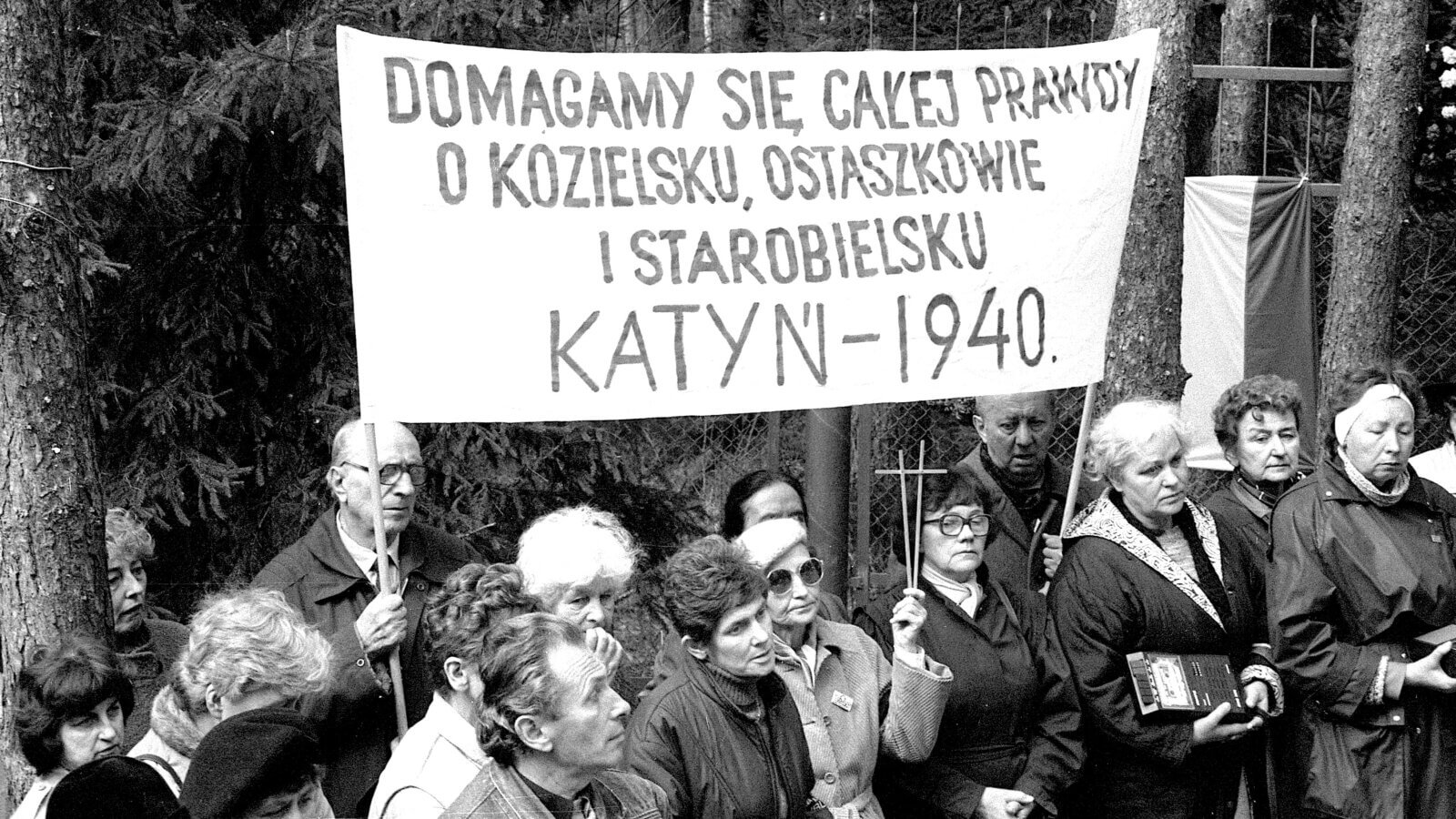
In the autumn of 1992, Russia experienced what appeared to be a miracle. For half a century, Moscow had blackmailed the free world into becoming a docile accomplice in sustaining the Katyn lie – the claim that it was “probably” the Germans, not the Russians, who had murdered 20,000 Polish prisoners of war during the Second World War.
The success of that endeavour was both remarkable and enduring. Indeed, many in Poland felt that European leaders and intellectuals viewed the distortion of the Katyn crime and the protection of the Russian culprits as something akin to a mission. As a result, Poles in post-war Europe, fighting alone and somewhat quixotically against this historical denialism, bore the brunt of resentment and frustration. It was only the United States, having unequivocally confirmed the truth of the Katyn crime via congressional declaration in 1952, that demonstrated the capacity for a swift and decisive rejection of the lie.
And then suddenly, in October 1992, Boris Yeltsin, of his own accord, handed Lech Wałęsa a file of documents relating to the Katyn crime. Among them was a copy of “Order No. 13” of 15 March 1940, signed by Stalin and the entire Soviet leadership, which set out plainly, in writing, an instruction to the NKVD to murder the Polish war prisoners. It seemed as though the entire edifice supporting the Katyn lie had crumbled into dust.
But nothing could have been further from the truth. The process of exposing the Katyn lie was particularly challenging and lengthy in Britain. It is hard to fathom that it wasn’t until David Cameron’s time as prime minister in 2012 – a full two decades after Yeltsin – that the British government declassified the documents that revealed the wartime understanding between Churchill and Roosevelt regarding Katyn.
In 1943, the two leaders had exchanged reports on the Soviet crime and quietly agreed that the Western public should never learn of it. How deeply the Katyn lie had seeped into the bloodstream of British politics is perhaps best illustrated by a later episode. In 1976, when a memorial to the victims was finally erected in a London cemetery – the only setting in England where this proved possible – the government of James Callaghan sought, by various means, to ensure that the date of the crime, 1940, did not appear on the monument, since it pointed directly to the NKVD as the perpetrators. One wonders what a contemporary Englishman makes of the fact that, not so very long ago, a democratic government was engaged in falsifying the dates of death of allied soldiers on a memorial in London. It truly seems like an absurd, Orwellian scenario.
In some respects, the situation in France was even worse. For years, Polish witnesses were not merely ignored but openly attacked and discredited. Among them was Józef Czapski, a great artist who searched the “Gulag archipelago” for the missing officers on behalf of the Polish state (though he never found them).
What a bitter paradox it was that towards the end of the war, the only intellectual in France to write openly about the NKVD crime was a fascist, Robert Brasillach, who in 1943 had travelled to Katyn with a group of journalists and seen the freshly opened mass graves. Brasillach spoke out against the Katyn lie and was subsequently sentenced to death for collaboration with Germany and executed on de Gaulle’s orders. The perversity of the story is sharpened by the fact that his presence in Katyn and the truthful account he published in the fascist press were among the charges brought against him. De Gaulle himself, in his voluminous war memoirs running to well over a thousand pages, took care not to mention Katyn even once. Marked, as he was, by the infection of the Katyn lie, he did he did not bring himself to speak the truth even later, when, writing in the 1950s, he was already an old man and, for a time at least, no longer shaping the course of politics.
The hopeful Yeltsin era proved brief. Under the new master of the Kremlin, the Katyn lie swiftly resumed its place as a cornerstone of Russia’s state doctrine. For a time, the investigation ordered by Yeltsin continued under the Russian prosecutor’s office, while Polish families of the murdered waited in hope for its findings. But Vladimir Putin soon moved to classify and conceal the materials produced in the course of that inquiry, including the testimonies of witnesses still alive at the time, and even of the NKVD executioners themselves. In April 1940, those men, with grim diligence and under conditions of strict secrecy, worked through the nights, verifying each prisoner’s identity before executing them in turn with a shot to the back of the head.
Later came a further, unexpected act in the drama of the Katyn lie. The families of the victims turned to the European Court of Human Rights in Strasbourg, seeking redress. However, the Court denied them aid, using an utterly absurd procedural excuse. They argued that since Moscow only agreed to the Court’s jurisdiction in 1998, it was too late by 2013 to make a judgement on Russia’s reversion to the Katyn lie. The memory of that blow from Strasbourg lingers in Poland, with the added bitterness that a court meant to uphold human rights protected the offenders.
Yet the dissenting voice of Judge Dean Spielmann is remembered too, with his stark judgement that the Court had “renounced its role as guardian of human rights in the face of one of the most atrocious crimes of the twentieth century.” All this unfolded shortly before the outbreak of war in Ukraine, at a moment when Europe, seemingly ignoring reality, was building its future on another false belief: that a partnership with Putin’s Moscow could be both viable and profitable.
Looking back from today’s perspective, we can plainly see that the Katyn lie was a primal falsehood, a kind of mother of all the lies Europe proved willing to accept under Russian pressure – and at times even without it. It has left a lasting scar on the conscience of post-war Europe, one that will not readily heal. That scar constantly reminds us of the cynical way European elites became involved in falsely reporting crimes against Poles, and how this involvement led not to promised lasting gains, but to shame and humiliation.