 For Bread and Freedom


Karol POLEJOWSKI
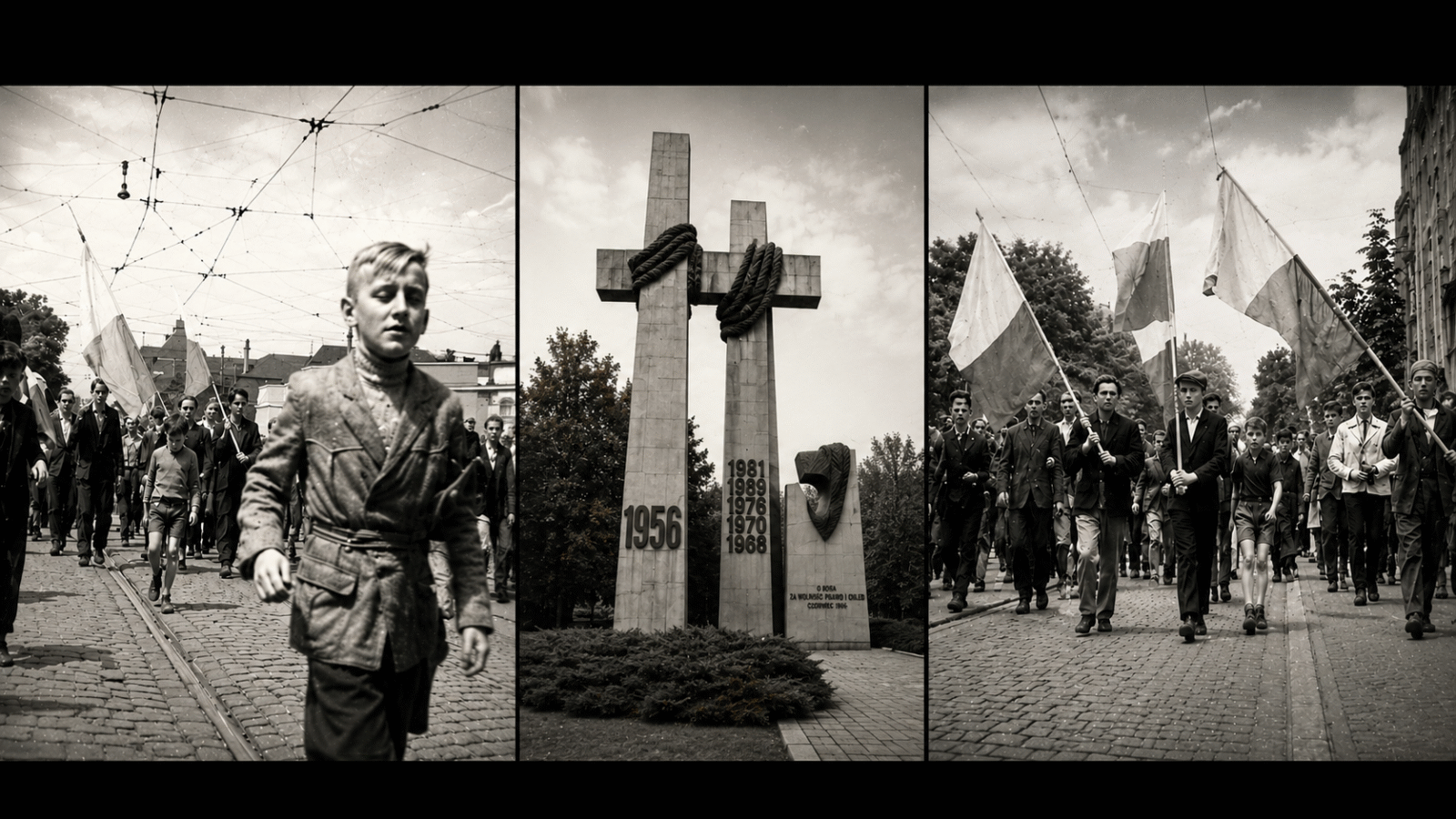
Seventy years ago, workers from the region’s largest factories, joined by the people of Poznań, courageously demanded a dignified life and independence. The authorities decided to deploy military force despite the initially peaceful nature of the demonstration. On 28 June 1956, a crowd of 100,000 demonstrators took to the streets to call for justice, improved working conditions, bread, freedom and the withdrawal of Soviet troops from the country.
.The obituary that appeared on 1 July 1956 in Głos Wielkopolski, a widely read Poznań daily, remains deeply moving even today. Parents ‘overcome by a grief beyond consolation’ announced that three days earlier their ‘beloved, only son’ Roman Strzałkowski had ‘met a tragic death’. Under communist censorship, it was impossible to say more; even so, the editors still intervened in the wording of the notice. The published version stated that the boy was ‘18 years old’, though in reality he was five years younger.
Strzałkowski was the youngest of the dozens killed during the Poznań June of 1956, one of the most tragic moments in Poland’s post-war history. It was the first mass workers’ uprising against communist rule between the Oder and the Bug. And it was not the only one drowned in blood.
The wall of fear begins to crack
.Present-day Poznań, a city of half a million people lying almost midway between Warsaw and Berlin, may rightly be called a city of freedom. In the 18th, 19th and 20th centuries, when the region was under Prussian rule, several Polish national rebellions broke out here. The last and best-known of them – the Greater Poland Uprising of 1918–1919 – effectively brought German rule to an end. But freedom and independence did not last long. The Second World War brought the people of Poznań five and a half years of brutal German occupation. Afterwards, Poland fell under a new form of subjugation, this time by a power from the east.
While the West celebrated victory over the Nazi Third Reich, many nations of Central and Eastern Europe were coming to terms with the grim reality of falling within the Soviet sphere of influence. In 1947, the communists rigged Poland’s parliamentary elections, and by the following election, they restricted candidacy to a single approved list. Within a few short years, they crushed opposition parties and the armed independence underground, while also bringing the trade unions firmly under state control. They also targeted the Catholic Church, with the internment in 1953 of Poland’s charismatic Primate, Cardinal Stefan Wyszyński, becoming the most striking symbol of the campaign.
Despite official propaganda proclaiming a ‘struggle against reaction’, the new regime oppressed the very people it claimed to represent: labourers, farmers and craftsmen. The government’s control over trade, attempts to collectivise agriculture and relentless investment in heavy industry at the expense of consumer goods severely harmed the quality of life for average people. A decent pair of shoes was priced at 400 zlotys, while a suit could cost as much as five times more, at a time when many people were forced to survive on only a few hundred zlotys a month. To make matters worse, many goods were simply unavailable, so whenever new deliveries appeared, enormous queues would immediately form outside the shops. The lack of available housing was another concern, compelling complete strangers into shared living arrangements. Flora Lewis, a correspondent for The Washington Post, spoke in Poznań with a twenty-six-year-old woman who had to share a small room with three other women for seven years. ‘All I want,’ she said, ‘is a room of my own.’
Lewis drew attention to an interesting phenomenon: social uprisings typically occur not when oppression is at its worst, but when a glimmer of hope appears. Joseph Stalin died in March 1953, and his Polish protégé, Bolesław Bierut, passed away three years later. At the same time, the first cautious signs of a political thaw began to emerge. A number of political prisoners were released, and articles that the regime would once have prevented from being published appeared in the press. News of Nikita Khrushchev’s secret speech on Stalinist crimes reached Poland from Moscow, causing a profound stir. In a nation long humiliated and subdued, the wall of fear was beginning to crack.
Tanks against the workers
.On the morning of 28 June 1956, the factory siren at the Joseph Stalin Metal Industry Works in Poznań sounded the call to strike. Conditions there had long been dire, with workers complaining of inflated production quotas, punitive wage taxes and poor health and safety standards. That Thursday, thousands of employees took to the streets and were soon joined by the staff from other factories across the city. In central Poznań, the crowd swelled to 100,000 people, which at the time amounted to nearly one-third of the city’s population. The banners carried by the protesters reflected both economic and political grievances, with slogans like ‘We Demand Bread’ and ‘We Want Free Elections’.
The final spark came with rumours that a delegation of workers, who had travelled to Warsaw to discuss their demands with the authorities, had been arrested. In central Poznań, demonstrators seized control of the prison. As they approached the headquarters of the Security Office, shots rang out from the windows. Fighting erupted, becoming all the more fierce as protesters in and around the city gained access to some weapons and ammunition.
All of this unfolded during the Poznań International Fair. ‘Hundreds of foreigners watched these events in astonishment, not knowing how or why the fighting had begun. Yet the meaning of the incidents was clear; those leaving Poznań carried abroad the first reports of bloody riots in Poland’, Lewis later recalled.
The influx of international visitors for the fair did not deter the communists from launching a violent counteroffensive. To crush the rebellion, the authorities deployed four army divisions, including two armoured ones, amassing over 9,000 soldiers and hundreds of tanks. By the evening of 28 June, the outcome of the unequal struggle was all but determined, although gunfire could still be heard across the city for the next two days. Several dozen people were killed and at least several hundred were wounded.
After quashing the revolt, the regime once again revealed its ugliest face. Prime Minister Józef Cyrankiewicz, sometimes portrayed as a cosmopolitan figure with a touch of pre-war sophistication, declared in a radio address that the authorities would ‘cut off the hand’ of anyone who dared to raise it ‘against the people’s government’. In the aftermath of the Poznań June protests, nearly 750 people were arrested. In autumn, despite a short period of political liberalisation, ten people were ultimately sentenced to several years’ imprisonment.
Unsubdued memory
.The authorities wanted the memory of the social uprising erased. The new leader of the Communist party Władysław Gomułka spoke openly of drawing a ‘mourning curtain of silence’ over the events. When shipyard workers took to the streets in December 1970, the law enforcers once again opened fire on protesting civilians. Yet the Polish spirit of freedom could not be subdued. The massive wave of strikes in August 1980 led to the creation of NSZZ ‘Solidarity’, the only independent trade union in the entire Eastern Bloc.
It was ‘Solidarity’ that successfully kept alive the memory of June ’56. In June 1981, on the twenty-fifth anniversary of the uprising, the Monument to the Victims of June 1956, also known as the Poznań Crosses, was erected in the city centre. Following Poland’s democratic transformation, tribute was paid there to the participants in the workers’ revolt by Pope John Paul II, foreign presidents and foreign ministers, as well as figures from beyond the world of high politics, including the renowned Hollywood actor Robert De Niro. In 2023, De Niro agreed to the request of the Institute of National Remembrance to send a few words to the veterans of June ’56. ‘To the Heroic Poznan Citizens of June 1956 anticommunism uprising with admiration and respect!’ he wrote.
History has shown time and again that oppressive regimes can triumph only in the short term. Communists drowned in blood the Central and Eastern Europeans’ desire for freedom, beginning with the events in East Berlin in June 1953, followed by Poznań in 1956, and culminating in the Hungarian Uprising in the fall of that same year. In doing so, however, they permanently stripped themselves of any moral legitimacy to exercise the power they had seized in Poland by force.