 The Katyń Wound

Karol POLEJOWSKI
Eighty-six years have passed since the Soviets executed thousands of Polish detainees and prisoners of war without trial. To this day, Russia struggles with the deeply uncomfortable reality of this genocidal crime.
‘I miss you and the children, yet for now I see no sign […] that this longing will become reality,’ wrote Władysław Dachowski, Second Lieutenant of the Reserve. It was early March 1940 at the Kozelsk Soviet prisoner-of-war camp. ‘Spring is approaching and the winter slumber is coming to an end. Perhaps an unknown journey lies ahead,’ noted the thirty-eight-year-old officer.
When the transports from Kozelsk began soon afterwards, many of the prisoners allowed themselves to hope they would return home, be handed over to Western powers, or at least sent to a neutral country. Instead, the trains arrived at Gnyozdovo station, near Smolensk. From there the prisoners, including Dachowski, were taken to the Katyń Forest and shot in the back of the head. At roughly the same time, other groups of Poles were being murdered in places such as Kharkiv and Kalinin. In total, in the spring of 1940 the Soviet NKVD killed nearly 22,000 Polish citizens, among them many officers and soldiers of the Polish Army, members of the Border Protection Corps and officers of the Polish Police and the Silesian Voivodeship Police. To this day, this genocide remains a painful wound in Poland’s national memory.
The Demise of the Polish Elites
It was nighttime when the Soviet dictator Joseph Stalin raised a toast in the Kremlin to Adolf Hitler and to the ‘revival of the traditional friendship between Germany and Russia.’ Just hours earlier, on the night of 23–24 August 1939, the foreign ministers of the USSR and the German Reich signed a non-aggression pact in Moscow whose secret protocol divided Central and Eastern Europe into spheres of influence between the two totalitarian powers. The road to war lay open. And indeed, on 1 September 1939 the German Wehrmacht invaded Poland. Two and a half weeks later it was joined by the Soviet Red Army.
The Polish military forces were unable to withstand the simultaneous attacks. After dividing the lands of the Polish Republic, the invaders imposed a regime of terror in the occupied territories. Right from the first months of the war the Polish elites faced brutal assaults from both occupiers. Mass executions in Piaśnica, Palmiry and numerous other locations across Pomerania and near Warsaw became emblematic of German atrocities during that era. Meanwhile, the Soviets set their sights on prisoners of war – officers of the Polish Army and other uniformed services, many of them reservists drawn from the ranks of the intelligentsia: doctors, lawyers, engineers and teachers (like Dachowski). In a memorandum to Stalin, the head of the NKVD Lavrentiy Beria described these officers as ‘impenitent enemies of the Soviet power, unlikely ever to improve,’ and called for them to be shot without trial. The Soviet Politburo approved this sinister proposal on 5 March 1940.
Soon the prisoners from the camps at Kozelsk, Starobilsk and Ostashkov were put to death, along with many other Polish citizens held in Soviet prisons. The families of the murdered also faced repression. Packed into cattle wagons, they were deported far to the east, to the ‘inhuman land.’ Such was the fate that befell Władysław Dachowski’s closest relatives: his wife Wilhelmina, his teenage daughter Irena and his several-year-old son Piotr. They were given half an hour to gather the most necessary belongings before being deported to the Kazakh Soviet Socialist Republic. After several years they were fortunate enough to return to Poland. Many others never got that chance.
Killing the Truth
The Katyń crime was meant never to come to light. Yet events unfolded differently. After Germany’s invasion of the USSR, German forces discovered the mass graves in the Katyń Forest (among the exhumed remains were those of Władysław Dachowski). In April 1943 they announced the discovery to the world, hoping to drive a wedge between the members of the anti-Hitler coalition. The Soviets countered by rejecting any accountability for the mass murder of Polish officers. At the high-profile proceedings before the International Military Tribunal in Nuremberg, they even attempted to attribute the crime to Germany. The lie about the perpetrators of the Katyń massacre became one of the founding myths of communist ‘People’s Poland’, established after the war under Soviet surveillance. For decades the truth about the massacre could not be spoken openly in the countries of the Eastern Bloc.
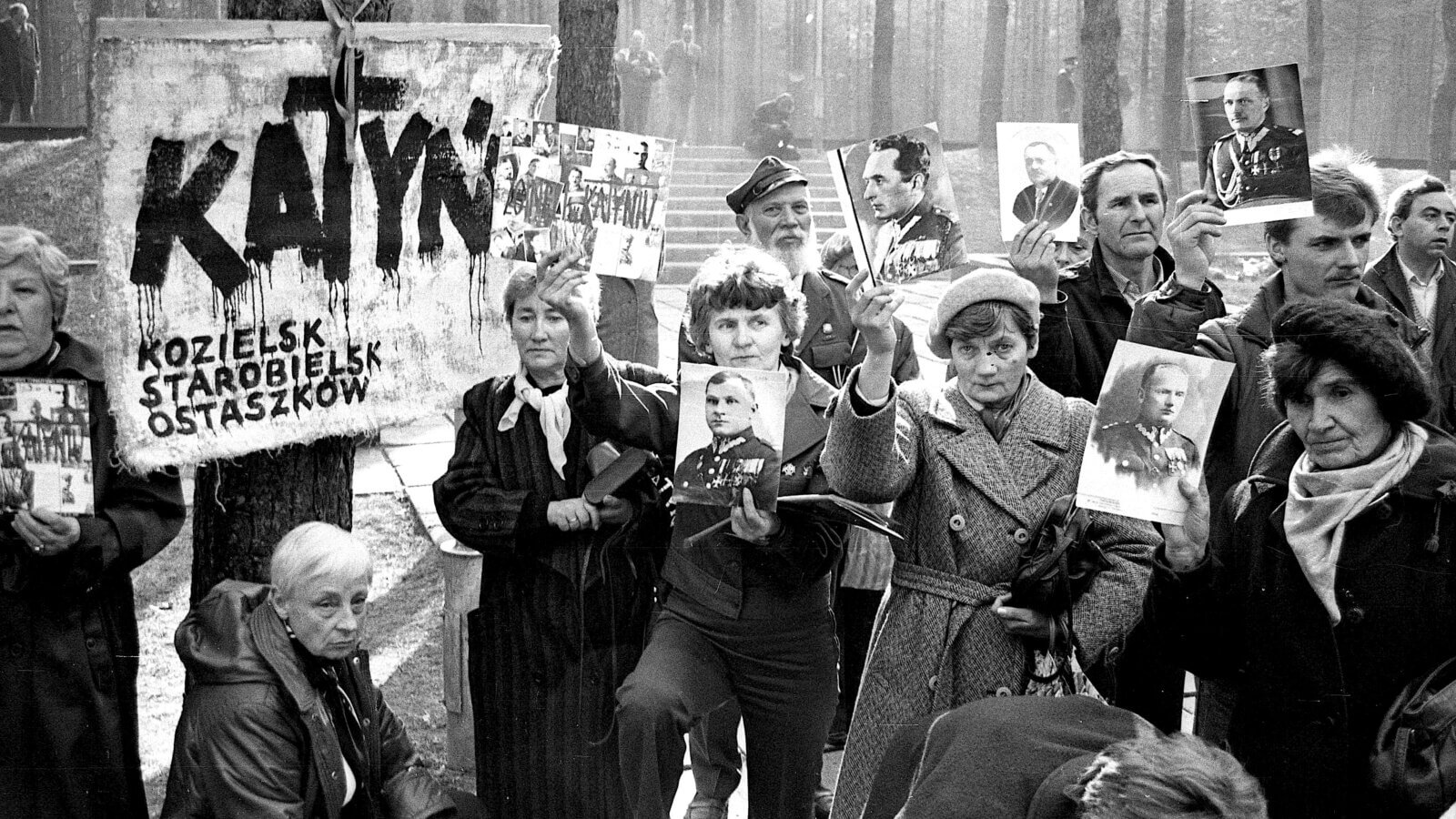
Yet social memory of Katyń endured, largely thanks to the families of the victims. Today, in a free Poland, the truth about the Soviet crime is widely known; it has become a lasting element of Polish historical consciousness and national identity. The Institute of National Remembrance plays a role in keeping this memory alive through its prosecutorial investigations, extensive scholarly research and numerous educational initiatives. For years the Institute has been involved in distributing Katyń buttons – badges whose form and design recall the buttons from Polish military coats recovered during the exhumations of the victims.
New Political Games Over Katyń
In the spring of 1990, as the Soviet empire of evil was visibly nearing collapse, the authorities in Moscow finally acknowledged that the Katyń massacre had been ‘one of the grave crimes of Stalinism’. In time it became possible to open Polish war cemeteries at Kharkiv, Katyń, Mednoye and Bykivnia. Today, however, the Kremlin has once again turned Katyń into a tool in a sordid political game. In Russia’s public sphere voices have reappeared seeking to attribute the crime to Germany. Last year this was compounded by the desecration of the war cemeteries in Mednoye and Katyń, where – on the orders of the Russian prosecutor’s office – Polish symbols were removed: the Cross of the September Campaign of 1939, commemorating the German and Soviet aggression of that year, and the Virtuti Militari, the highest Polish military decoration, established in 1792 to mark victory over Russia.
The Burials of the Victims
For us, raised in the Christian tradition, respect for the dead and care for their dignified burial has always been one of the hallmarks of civilisation. On 17 September 2025, the anniversary of the Soviet invasion of Poland, the remains of victims of the Katyń massacre – which had earlier been brought to Poland and remained in the custody of the prosecutor’s office – were laid to rest in the Field Cathedral of the Polish Army in Warsaw. A month later, an unknown police officer, murdered by the Soviets in Kalinin, was buried in the courtyard of the Regional Police Headquarters in Katowice. Furthermore, on March 5th of this year, marking the anniversary of the Soviet Politburo’s criminal decision to execute Polish prisoners of war and detainees, further Katyń victims were buried in Wrocław. We pay tribute to those who died for Poland and reunite their remains with their families. Let us ensure that the truth concerning the Katyn massacre is preserved for future generations.
The Katyń Timeline
23 August 1939 – Nazi Germany and the Soviet Union sign a non-aggression pact (the so-called Molotov–Ribbentrop Pact), which includes a secret protocol allocating spheres of influence in Central and Eastern Europe between the two powers.
17 September 1939 – the Soviet Union invades Poland and captures thousands of Poles, mainly soldiers of the Polish Army and officers of the State Police, as prisoners of war.
5 March 1940 – the Politburo of the Central Committee of the Communist Party (Bolsheviks), headed by Joseph Stalin, adopts a resolution affecting more than 25,000 Polish citizens, including nearly 15,000 prisoners of war and about 11,000 civilians.
April–May 1940 – Soviet authorities carry out mass executions in Katyń, Kharkiv, Kalinin and other execution sites in the Soviet Union.
22 June 1941 – Nazi Germany attacks the Soviet Union.
13 April 1943 – Radio Berlin announces the discovery of mass graves of Polish officers murdered by the GPU in the Katyń Forest.
17 April 1943 – the Polish government-in-exile in London requests the International Committee of the Red Cross (ICRC) to investigate the mass graves of Polish officers discovered by the Germans.
25 April 1943 – the Soviet Union suspends diplomatic relations with the Polish government-in-exile, accusing Poland of cooperating with Germany.
13 January 1944 – the Soviet Union establishes the so-called Burdenko Commission aimed at placing the blame for the massacre on the Germans.
1945–1946 – representatives of the Soviet Union attempt to include the Katyń case in the indictment at the Nuremberg Trials in an effort to shift responsibility for the crime onto Germany.
1944–1989 – in communist-ruled Poland the official stance is that Germany committed the Katyń Crime, and those who try to reveal the truth about the execution sites of Polish officers in the Soviet Union face repression.
August 1980 – the independent social movement Solidarity emerges and creates space for public debate about the crimes of communism, including the Katyń Crime.
13 April 1990 – the Soviet authorities admit responsibility for the Katyń massacre, describing it as ‘one of the gravest crimes of Stalinism’.
14 October 1992 – the President of the Russian Federation, Boris Yeltsin, hands over to Poland copies of key documents concerning the Katyń Crime, including the Politburo resolution of 5 March 1940.
2000 – Poland opens the Polish War Cemeteries in Katyń, Mednoye and Kharkiv.
2004 – the Main Military Prosecutor’s Office of the Russian Federation discontinues its investigation into the Katyń Crime. In response, the Institute of National Remembrance in Poland opens its own investigation.
After 2005 – the Russian authorities suspend cooperation with Poland in the investigation of the Katyń Crime, refusing legal assistance and full access to the files of the Russian investigation.
10 April 2010 – a Polish government aircraft carrying a delegation of senior Polish state officials, headed by President Lech Kaczyński and travelling to attend the 70th anniversary commemorations of the Katyń Crime, crashes near Smolensk; ninety-six people are killed in the catastrophe.
After 2014 – Russia attacks Ukraine, returns to an imperial policy and revives the narrative that the Katyń Crime was committed by the Germans, moving further away from any legal or historical reckoning with the crime.