 Was Chopin an Important Influence on Weinberg?





Prof. David FANNING
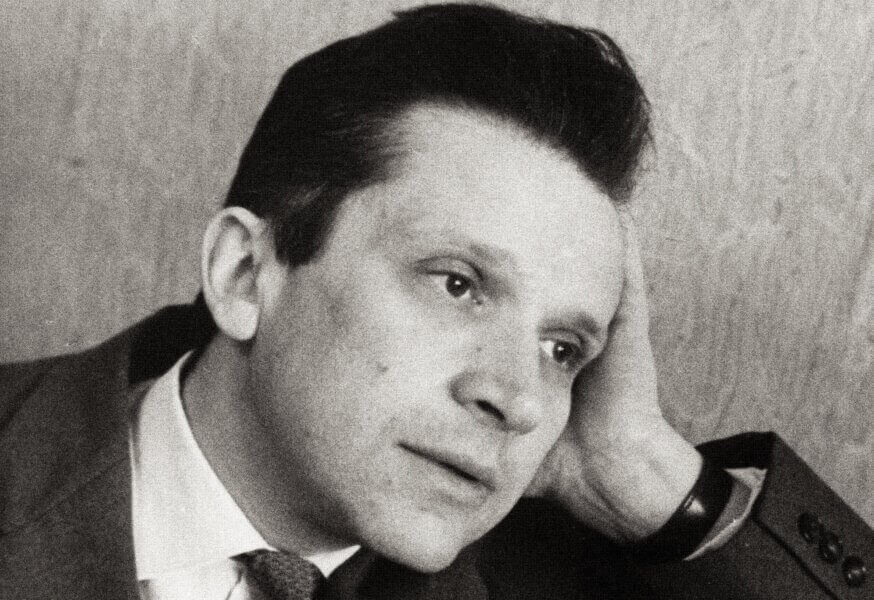
On the day of his 75th birthday (8 December 1994) with only 15 months to live, the already bedridden Mieczsyław Weinberg received numerous telephone congratulations and visits in his apartment.
.At around 5.00 or 6.00pm Eugeniusz Mielcarek from the Polish embassy in Moscow arrived. He stayed with Weinberg alone in his study for a little more than an hour, during which he bestowed the gold medal of the Polish Distinguished Culture Service Award. They talked about the Warsaw of the composer’s youth, and Weinberg explained the pain of having artistic ideas in his head but being physically unable to commit them to paper. He added that ‘Fortunately there is still wonderful Polish music. Every day I play Chopin’s pieces in my head and I listen to the Moniuszko operas.’
Of course this may merely have been said out of politeness. Equally, though, it would be surprising if any pianist-composer growing up in Warsaw in the 1920s and 30s did not remain deeply attached to Chopin’s music, wherever directions their life and career took subsequently. What is more surprising is that Weinberg said so little about Weinberg in any of his published articles or interviews. The only other statement we have of this kind is a snippet within an ‘Address to our Polish Friends’, published in from 1969 to mark ‘25 years since the day Poland was freed by the Soviet Army from the yoke of Hitlerism’. There he wrote: ‘I was born in Warsaw, graduated from the Warsaw Conservatoire, and was brought up on the national poetry (among the finest in the world) and in a musical milieu dominated by the cult of Chopin.’
Perhaps we should not read too much into the seemingly derogatory word ‘cult’. But he certainly offered no elaboration. Instead, he went on to celebrate Polish literature and cinema, rather pointedly avoiding mention of post-war Polish music, which was regarded in the Soviet Union with intense suspicion for its supposed dalliance with Western avant-garde idioms. Again, Weinberg may have been looking over his shoulder at possible official disapproval. His comments may even have been censored by the magazine he was publishing in (Sovetskaya muzyka). At any rate, his reluctance to engage publicly with the music of his homeland can be read as the other side of the coin from the suspicion he himself encountered on his one and only return visit to Poland, at the time of the 1966 Warsaw Autumn Festival, when he was in effect regarded as more Soviet than Polish.
So, the question of Chopin’s influence on Weinberg remains an open one. We can only address it based on the evidence of his music. Rather than giving an unequivocal answer, we can usefully suggest what kind of influence it was, what degree of importance it had in relation to other influences, at what points in his career it manifested itself, why then, and to what purpose?
It may be worth giving some provisional answers before arguing the case fully. The Chopin influence was generally more indirect than direct. In so far as it was direct (involving literal musical quotation) it operated more on a symbolic level than a purely musical one. In terms of Weinberg’s musical style, the influence of Chopin was less overtly significant than that of Mahler or Shostakovich – we might say that it was more subcutaneous. And it manifested itself mainly in the second half of his composing career, for reasons intimately bound up with his thoughts about his Polish homeland and the associated acute sense of loss.
And now to put some flesh on these bare bones.
Little is known about Weinberg’s early life with any certainty. As a seven-year-old boy, he was in Warsaw at the time of the first Chopin competition in March 1927. But that was three years before he began playing the piano at his father’s musical theatre and five before he began taking piano lessons from a lady by the name of Mrs Matulewicz (first name unknown) who ran a music school in Warsaw. It is a pleasing fantasy to imagine a wide-eyed Metek discovering the music of his greatest compatriot at the hands of a galaxy of young talents, including Shostakovich, Ginsburg and Oborin from the Soviet Union. Maybe a creative-minded film-maker could make something of the idea sometime in the future. But in reality, Weinberg never mentioned the competition in any documented source, and it seems highly unlikely that he was present.
There was no piano in the young boy’s family home, and he went to practice at the home of his cousin, Felicya. Recognising his talent, Mrs Matulewicz soon referred him on to the Warsaw Conservatoire, which he enrolled in September 1931, and where he came under the supervision of Józef Turczyński (1884–1953). From this point, the Chopin influence would have been absolutely unavoidable. Polish readers need no reminder of Turczyński’s role as co-editor of the Chopin Complete Edition (further West, it is generally referred to in short as the Paderewski edition). Turczyński reportedly considered Weinberg and Witold Małcużyński his two best students. Certainly, with Rachmaninoff’s Third Piano Concerto as a graduation piece, and with an endorsement from Józef Hofmann on the strength of his playing of Balakirev’s Islamey, nothing in the standard piano repertoire would have held any terrors for the 19-year-old at the end of his Warsaw studies. He did recall in later life how he thrilled to the playing of Sauer and Friedman (the latter also a Chopin editor, as well as a fabulous exponent). And yet we can only guess what specific Chopin repertoire Weinberg learned as a student.
We do know that when he made his dramatic escape from the Nazi invasion, he took with him just a select few of his self-taught compositions. Those few included two Mazurkas for Piano, composed in 1933 and carrying a dedication to Turczyński, as well as a Lullaby composed in 1935. Even then, the expected Chopin influence on those pieces lies far from the surface. If anything, the Mazurkas are more reminiscent of Szymanowski, in their flirtations with bitonality and grotesque characterisation, while the Lullaby’s festooned chromaticism recalls the same composer in more romantic vein.
The stylistic influence, then, is indirect. It is a matter of Chopinesque genres passed down via Szymanowski. Having said that, the symbolic importance of those genres would certainly resonate down through Weinberg’s composing career. The A minor Mazurka evidently became some kind of symbol for his lost homeland, since he quoted it in his String Quartet No. 16, Op. 130 (1981) (dedicated to the memory of his sister, who perished under the Nazis), in the song ‘Memorial’, Op. 132 (1981), and in the finale of his Symphony No. 20, Op. 150 (1988). The lullaby, meanwhile, became one his most characteristic modes of expression, with rocking pairs of intervals virtually a signature motif; a succession of lullabies comprises one of Weinberg’s finest song-cycles, Lulling the Child, Op. 110. Consolation and childlike innocence became the complementary opposite to stern denunciation in his repertoire of characteristic moods.
Weinberg was taken still further away from direct engagement with Chopin by his encounter with the music of Shostakovich. This happened during his first exile, in Minsk, and he likened it to ‘the discovery of a continent’. Shostakovich’s music spoke to Weinberg with the voice of its own times and led to a complete reorientation of his stylistic compass, away from the impressionism and neo-impressionism to which (by his own admission but without naming Szymanowski or any other figure) he had previously felt drawn. His own piano writing, both in solo sonatas and in a succession of first-rate piano-chamber works composed during his first years in Moscow (from 1943), took on a harder edge, with little or no room for filigree elaboration or seductive sonority.
It was extra-musical pressures that soon took him back to musical thoughts of his homeland. The Soviet Union’s post-war ‘anti-formalist’ campaign, spearheaded by Party functionary Andrey Zhdanov, targeted film-makers in 1946 and writers since 1947. But the ferocity with which it hit composers in 1948 was particularly marked. As a young composer still making his mark, Weinberg was shielded to some extent from its worst effects. At the same time, precisely because of his outstanding promise and his quickly established position as one of the leading composers of his generation, he became a target for jealousy and for patronising critiques. Four of his most recent works were included on the notorious blacklist of music ‘not recommended for performance’. Taking note of the new imperatives of writing Music for (or comprehensible to, or somehow relatable to the experience of) the People, and yet unwilling to compromise any more of his artistic identity than was absolutely necessary, he turned to the folk idioms of Poland (also Moravia) to keep his music, and his soul, alive.
The four-movement suite of Polish Tunes, Op. 47 No. 2, composed in 1950, soon after the better-known Jewish-inflected Sinfonietta No. 1 and Moldavian Rhapsody, is a charming, if light opus, of more interest for extrinsic reasons than for its intrinsic quality. Its characteristic flavours of mazurka, polka and waltz register immediately, and probably not only to Chopin-attuned ears. So, too, the abundant Lydian-mode (sharpened-fourth degree) inflections, heard at the beginning of the short introductory movement. These would become a strong marker for Polish characters and topics in the more serious contexts of a number of Weinberg’s later works, above all in the Polish-village scenes of his second opera, The Madonna and the Soldier, but also in works with no particular Polish agenda, such as the Violin Concerto of 1959, where all four movements are so coloured.
Not long after the Polish Tunes, allusions to specific works of Chopin began to creep into Weinberg’s output. Once again, we might suspect extra-musical motivations. In the Partita for Piano, Op. 54, the second work Weinberg composed after his release from a brief period of imprisonment on trumped-up charges of ‘Jewish bourgeois nationalism’, the penultimate movement is an Etude, in rushing parallel motion between the hands that clearly emulates the ‘wind-over-the-graves’ texture of the finale of Chopin’s ‘Funeral March’ Sonata. That piece that would feature more dramatically in his output, and with more overt symbolism, just a few years later.
It is with the Eighth Symphony, a ten-movement cantata-symphony setting verses of Weinberg’s favourite poet, Julian Tuwim, that the Chopin connection comes unmistakably to the fore. He composed it in 1964, at the same time as his thoughts were turning to his first opera, the Auschwitz-based opera The Passenger, which would take him a further four years to complete. In the Symphony, the narrative thread of the selected poems leads from the social miseries of pre-war Poland to the horrors of Nazi occupation. After the midway point, the sixth and seventh movements constitute the outraged heart of the Symphony. ‘A Lesson’, calls on the children of Warsaw to study their native tongue and to denounce the vampires who have desecrated their city. After a climax of focused rage and a superbly controlled fragmentation, the movement concludes with the bass tuba lugubriously intoning a fragment of Chopin’s ‘Funeral March’ Sonata, as if to bring home the sense of devastation. In the next movement the ‘Warsaw dogs’ are called upon to exact a terrible revenge on the occupiers, in an outpouring of musical vitriol that seems to have two decades of suppressed rage behind it. This movement again concludes by invoking the Chopin Funeral March, and the dual reference unmistakably stamps the symphony as a requiem for the lost homeland.
Aleksander Laskowski has also pointed to a subtle, but to Polish readers unmistakable, reference to Chopin in the eighth movement of the same Symphony, ‘The Mother’. It comes in the penultimate verse, where the line ‘ideał sięgnął bruku’ (the ideal was brought low to the cobblestone) is a quote from ‘one of the most famous romantic poems in the Polish culture, Cyprian Kamil Norwid’s “Chopin’s Piano”’. Written in 1863-1864, the poem refers to an unsuccessful by Polish anti-Tsarist attempt on the life of the Russian governor of Poland, Theodore Berg, in retaliation for which Russians threw Chopin’s Warsaw piano out of the window. The ‘ideal’ is ‘Chopin’s oeuvre as an idealised synthesis of the Mediterranean, Christian and Polish traditions’, and the destruction of his piano symbolises the destruction of that ideal. By extension, Tuwim uses the image to refer to his mother, who was killed by the Nazis in 1942, just as Weinberg’s mother had been at around the same time. Here, then, is a deeply concealed symbolic invocation of Chopin, at a level that Russian listeners would have been unlikely to pick up but Polish ones surely would have. Combined with the overt quotations from the Funeral March Sonata, the Chopin references point to the Symphony’s message about the destruction of cultural memory: at once deeply personal to Weinberg and profoundly resonant with the experience of his homeland.
After the Eighth Symphony, the works most directly engaged with the Polish experience are Weinberg’s Ninth Symphony: ‘Verses that have Escaped Destruction’, and his second opera, Thue Madonna and the Soldier. Both are highly problematic in their celebration of the liberation of Poland by the Red Army. Neither contains any overt or covert reference to Chopin. However, delving into Weinberg’s film scores of the time and afterwards, show a continuing engagement with Chopin. Tatyanin den (Tatyana’s Name-day, 1967), includes a rather convincing Chopinesque mazurka. And the fairy-tale Oslinaya shkura (The Hide of a Donkey, 1981–82), which tells of a beautiful princess who has to escape an incestuous marriage to her father when his wife dies, in which process she is helped by disguising herself in the skin of a magic donkey, features a lengthy improvisatory quasi-Chopin waltz when the disguised princess imagines that she is reunited with her prince. Neither of these Chopin paraphrases can count as significant except as indications that the music was constantly available to Weinberg’s memory whenever the occasion arose.
.That Chopin remained on Weinberg’s radar is clear. The influence may not have been consistent or continuous throughout his life. But it certainly ran deep, and in the Eighth and Twenty-first Symphonies it was a vital support to two of his most profound and compassionate humanistic utterances.