 Chopin’s Music and the Upper Classes




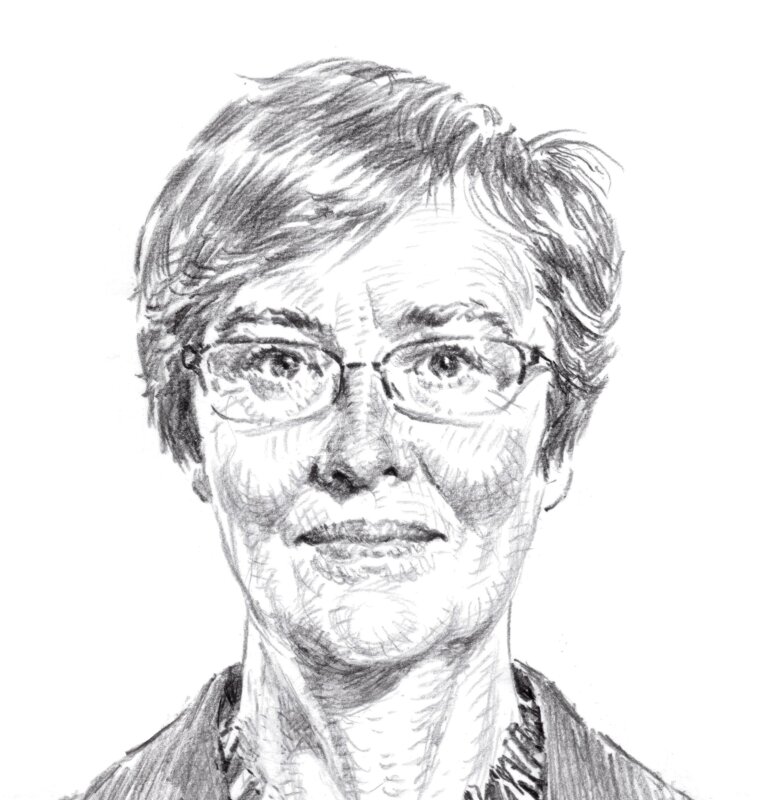
Prof. Magdalena DZIADEK
After 1918, public reverence for Fryderyk Chopin flourished in Poland, rooted in particularly firm ground.
.In Chopin’s obituary published in Signale für die musikalische Welt, it was clearly noted that he died ‘in the arms of his favourite pupils and his sister who had travelled from Warsaw’. Indeed, the role of the dames patronnes, women who considered it their noble duty to support the composer materially and morally, was highly valued. Chopin’s female patrons also appeared in large numbers at his funeral. ‘Some arrived from London, Vienna and Berlin,’ marvelled Henri Blanchard, critic of the Parisian Gazette et Revue musicale. For us, however, the most significant figures are the composer’s Polish patrons, who continued this role after returning home. Foremost among them was his sister Ludwika (1807–1855), who discreetly kept watch, on behalf of the family, over how Chopin was portrayed in the press. One of the aims was to counter rumours that he had remained an agnostic. To that end, the family enlisted the authority of Father Aleksander Jełowicki (1804–1877), the renowned confessor of the Paris Polish community. Four days after Chopin’s death, Jełowicki published in the French journal La Semaine religieuse an open letter addressed to the well-known Polish patriotic activist Xawera Grocholska, describing his ministry at the dying composer’s bedside. He wrote of Chopin’s conversion in his final hours, his confession and his reception of the viaticum. The letter was soon reprinted, in translation, by several Polish periodicals.
Father Jełowicki appears in the left-hand corner of Teofil Kwiatkowski’s well-known painting The Last Moments of Chopin. In the foreground stands Princess Marcelina Czartoryska (née Radziwiłł, 1817–1894), who in the middle decades of the nineteenth century was an active promoter of Chopin’s music and a devoted collector of memorabilia connected with him. Her collection included Chopin’s piano, his death mask, a cast of his hand, a lock of his hair, a withered bouquet taken from his coffin by George Sand’s daughter Solange, several copies or sketches of portraits of the composer, and various gifts he had received from prominent figures. Some of these items – among them the notebook known as the ‘Stuttgart Diary’ – she later passed on to relatives; others became part of the Czartoryski Museum in Kraków, opened in 1888. Princess Marcelina Czartoryska attracted considerable attention as a member of Chopin’s closest circle. A well-known drawing by Norwid shows Chopin making music in her Paris salon. Above all, however, she was recognised as the master’s pupil, someone believed to possess the secret of the authentic style of his playing. She performed his works in public, including the preludes and mazurkas, the Polonaise in A major, the Polonaise-Fantasy and the Funeral March from the Sonata in B-flat minor, both in Paris and in Kraków, where she settled permanently in 1870. One of her more striking initiatives there was the organisation of a lecture on Chopin illustrated by her own performances of his music. To deliver the lecture, she invited Count Stanisław Tarnowski (1837–1917), whom she had known since their Paris years, when he was associated with the Polish Bureau established by the Hôtel Lambert. Since then, Tarnowski had gone on to build a distinguished career as a politician, journal editor and philologist, and from 1870 he was affiliated with the Jagiellonian University. Drawing on the authority of his newly minted doctorate, he put forward in his lecture – later published several times under the modest title A Few Words on Chopin – a bold proposal to consider Chopin’s significance from a patriotic perspective, as a representative of a sound Polish spirit, capable of imposing not only artistic but also moral principles upon a decadent West. This line of thought was subsequently taken up by other apologists of the Chopinian muse, who idealised the composer’s image in the name of higher political aims.
These initiatives found their strongest reception in Galicia, where the recently acquired political liberties enabled Poles to openly demonstrate their patriotism. In the Russian partition the situation was more difficult due to censorship that prohibited such manifestations. Even there, however, ways were found to convey to a wider public the significance of Chopin’s music as a force capable of healing both the nation and the world. In 1879 and 1883, Jan Kleczyński (1837–1895) gave a series of lectures on Chopin in Warsaw. A Paris-trained pianist and music critic, he styled himself as Chopin’s ‘musical grandson’, claiming this status on the grounds that he consulted his interpretations of Chopin’s music with Princess Marcelina Czartoryska. Although the stated aim of his lectures was to familiarise audiences with Chopin’s pianistic style – hence their title, On the Performance of Chopin’s Works – they also conveyed, between the lines, ideas closely aligned with those developed by the Kraków circle associated with Tarnowski and Czartoryska. Thanks to the pianist Natalia Janotha, educated in Warsaw and in Germany (including under Clara Schumann), Kleczyński’s lectures reached Western audiences in English and German translations. Janotha herself played a vital role in promoting Chopin’s legacy: she performed his works widely and published, from a manuscript in her possession, the early composition Fugue in A minor. Janotha also determined, based on her reading of the baptismal register, that Chopin was born on February 22, 1810, a date that was widely accepted until recently.
At the time when the first series of lectures was being prepared, Kleczyński served as director of the Warsaw Music Society, founded in 1871, an institution whose statutes explicitly granted it both the privilege and the obligation to promote appreciation of Chopin (to this end, a dedicated Chopin Section was established). Among the Society’s founding members was Countess Maria Kalergis (1822–1874), brought up in St Petersburg and of mixed Russian and Polish background, an accomplished pianist of exceptional talent. During her stay in Paris, she took lessons with Chopin, who publicly praised her musical ability. From 1857 she lived in Warsaw, where she hosted a salon attended predominantly by Russians, while her summers were spent in Baden-Baden. Her residence there, the Villa Kalergis, became a meeting place for Europe’s elite, frequented by celebrated musicians such as Liszt, the young Wagner – whose Paris staging of Tannhäuser she helped finance – and the pianist Hans von Bülow. The latter went so far as to describe Maria Kalergis as the finest interpreter of Chopin’s works he had ever heard.
Maria Kalergis also acted as a patron in Warsaw, notably in relation to Stanisław Moniuszko, whom she helped gain access to the Warsaw theatre stage and whom she supported in his journey to Paris. As part of the large-scale charity concerts she organised to raise funds for this trip, she herself performed Chopin’s works, including Rondo à la Mazur.
Chopin was widely discussed in Warsaw’s literary salons and among women active in publishing and journalism. These circles included representatives of the generation of emancipated women, such as Eleonora Ziemięcka and Aleksandra Borkowska (née Chomętowska), as well as the celebrated improvising poet Jadwiga Łuszczewska (Deotyma) (1834–1908), the author of several poems devoted to Chopin.
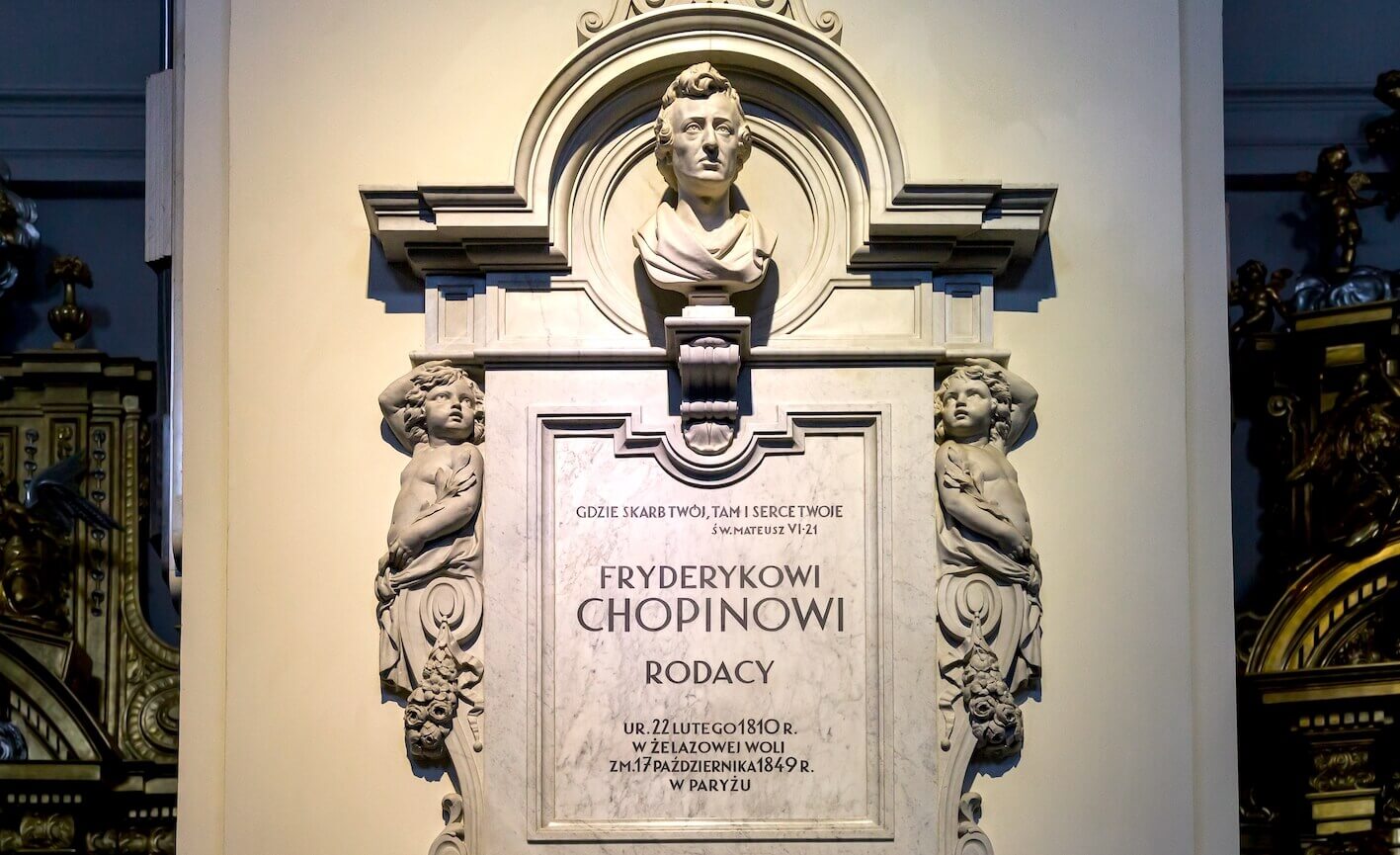
By the end of the nineteenth century, successive activists of the Warsaw Music Society, drawn from both the musical community and the city’s multinational patrician class, took up the task of cultivating public reverence for Chopin in Warsaw. From its earliest years, the Society organised public commemorations of the anniversaries of Chopin’s birth and death. The first such celebration took place in 1873. It was also on the Society’s initiative that the urn containing Chopin’s heart was immured in a pillar of the Church of the Holy Cross, an event that occurred in 1880. Among the leading figures in the Society’s Chopin Section at a later time were the distinguished philologist and ethnologist Jan Karłowicz and his son Mieczysław, a renowned composer who in 1904 issued the collection titled Previously Unpublished Memorabilia of Chopin. The volume contained a substantial body of first editions of never-before-seen correspondence, including letters by Madame Sand and her daughter, the Wodziński family and Chopin’s pupils and acquaintances.
A few important points should be made about the reverence for Chopin in nineteenth-century Greater Poland. It was there that the first two biographers of Chopin were active: Antoni Woykowski and Marceli Antoni Szulc. Both were well acquainted with the circumstances linking the young Chopin to the family of Prince Antoni Radziwiłł and discussed in meticulous detail the composer’s stays at the Radziwiłł palaces in Poznań and Antonin. Overshadowed by these Poznań-based biographical debates was a valuable contribution to Chopin studies by Cecylia Działyńska (1836–1899), the Kórnik heiress and niece of Marcelina Czartoryska. Music was not the principal field of interest of this remarkable figure, who was a patriotic activist, philanthropist and member of the Third Order of the Dominicans, yet it is worth noting that in 1892 she published in Kurier Warszawski an article entitled How to Play Chopin?, which offered a summary of the views held by her celebrated aunt.
Going back to the Galician context, let us turn to Lviv, where a more extensive circle of Chopin enthusiasts emerged towards the close of the nineteenth century. The initiative was led by Karol Mikuli (1819–1897), a pianist, composer and pedagogue, not to mention one of Chopin’s pupils, who studied with him at the same time as Marcelina Czartoryska. Mikuli secured a lasting place in the history of Polish music in two ways. He prepared the complete seventeen-volume edition of Chopin’s works, published in the late 1870s by the Leipzig firm of Kistner. Above all, however, he trained a group of pianists who went on to achieve international renown as interpreters of Chopin, among them Moritz Rosenthal, Raoul Koczalski and Aleksander Michałowski. For many years president of the Galician Music Society, Mikuli was also active on the social front, gathering around him a circle of amateurs drawn to Chopin’s music. Among them were the bookseller Karol Wild and his wife Leonia, to whom the poet Kornel Ujejski, enamoured of her, dedicated his celebrated Translations of Chopin, poems that interpret selected works by the composer in both content and form. Another key figure was Kornelia Parnasowa, a member of the patrician class and a pianist trained by Mikuli, who owned a palace on Piekarska Street, where she established a private Chopin museum open to the public, which hosted concerts and lectures. Its collections included, among other items, Maria Wodzińska’s album (published at Parnasowa’s own expense in Polish and French in Leipzig) and the autograph manuscript of an early piece, the Largo in C minor.
The political climate and the significant veneration of Chopin in Lviv led to the city being the site of the national celebrations for the composer’s birth centenary in 1910. The appointed organising committee’s makeup perfectly mirrored the Austro-Hungarian monarchy’s conciliatory spirit. The committee was headed jointly by three figures: Aleksander Tchorznicki, a landowner, judge and court chamberlain, privately a devoted music lover who played Chopin extensively and would later found the Lviv Chopin Society; Aleksander Krechowiecki, a writer and editor of the official daily Gazeta Lwowska, who also served as regional censor; and Mieczysław Sołtys, a composer and at the time president of the Galician Music Society. At the invitation of this distinguished group, Ignacy Jan Paderewski travelled to Lviv for the celebrations. Since the Dresden premiere of his opera Manru in 1902, Paderewski had been openly engaged in political activity directed against Prussian policy. In the summer of 1910, he unveiled in Kraków the monument to King Władysław Jagiełło that he himself had funded, marking the five-hundredth anniversary of Poland’s victory at Grunwald. The ceremony was preceded by months of controversy, as some politicians – supported by a sizeable segment of Warsaw journalists – accused the organisers of yielding to official pressure to downplay the event’s anti-German significance. By contrast, the commemoration of Chopin provoked no such disputes, thus rendering it an expected force of national integration and a catalyst for patriotic sentiment. Paderewski was greeted in Lviv according to 19th-century ceremonial convention, with students harnessing themselves to his carriage and a procession of girls dressed in white marching ahead and scattering flowers. The dignitaries present, acting as symbolic leaders of public opinion, made conspicuous displays of patriotism. Count Stanisław Tarnowski, for example, appeared dressed in traditional noble costume. The Lviv celebrations thus took on the character of an elite occasion, though they were not devoid of the customary Galician ‘folk’ elements. Among these was the formation of a vast peasant choir assembled to perform national songs.
Until the outbreak of the First World War, Paderewski was associated with numerous initiatives aimed at cultivating and promoting Chopin’s legacy. He largely represented Chopin’s music internationally during this era, only occasionally performing in Poland, with his last pre-war concert held in Warsaw in March 1913. In his recitals in Paris, London, the Americas, Australia and New Zealand, he regularly wove Chopin’s works into his programmes; the Polonaise in A major was particularly prominent and became his signature piece, alongside his renowned Minuet.
A distinct circle of Chopin enthusiasts also emerged from the women’s milieu that had been particularly active since the late nineteenth century. The conservative Polish Women Landowners’ Association and the liberal, albeit operating illegally, Circle of Women of the Crown and Lithuania emerged as competing organisations. In musical terms, however, the Circle of Ladies, founded in 1905 at the Warsaw Music Society, was of greater significance. Its leading figures were the ‘lionesses’ of Warsaw’s salons: Princess Maria Lubomirska, Józefina Kronenberg (née Reszke) and Hortensja Lewentalowa. The luxurious interiors of their cosmopolitan residences hosted numerous Chopin concerts.
In the final decades before the war, intellectual circles played the decisive role in promoting Chopin’s legacy on a broad social scale, particularly those circles that became politically active under the influence of the National Democracy movement. In provincial cities such as Poznań, Kraków and Łódź, Chopin societies sprang up, while professional musicians took it upon themselves to safeguard matters connected with the composer’s works. In keeping with the character of nineteenth-century musical culture – which was to a large extent a culture of the written word – Chopin-related writing also developed on a considerable scale. Lectures and informal talks multiplied, a number of books on Chopin appeared, and the press positively blossomed with poems devoted to the composer and his music. Many of these texts were penned by women from a range of social backgrounds. Some came from ‘society’, such as Amalia Pruszakowa (née Christiani), a well-born young woman who attended the Warsaw concerts of the young Chopin, and Janina Górska (née Mniszek-Tchorznicka). Others represented the middle classes, including the “fighters” like Maria Konopnicka, Natalia Dzierżkówna and Waleria Szalay-Groele, and writers associated with Young Poland impressionism, such as Maria Fedorowiczowa, Anna Neumann and Maria Kazecka.
.Taken together, all these initiatives, more or less serious in intent, laid the solid foundations for the public reverence for Chopin that flourished in Poland after 1918.The professional dimension of this phenomenon is fairly well-documented, but the part that involves refined amateur participation requires much more research and systematisation.